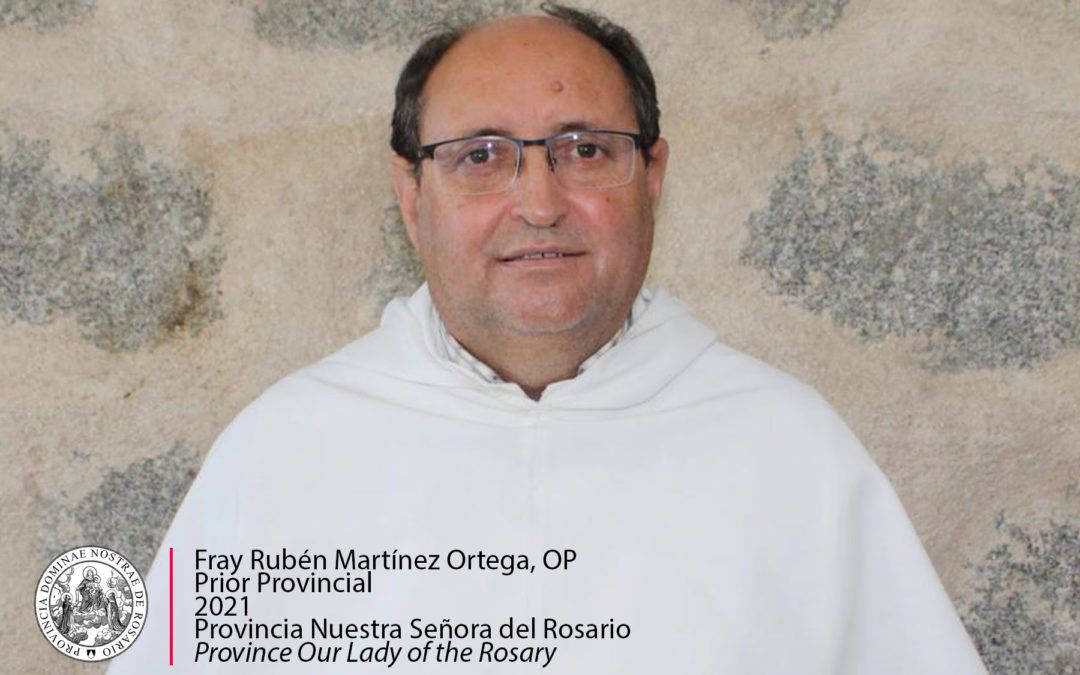
Father Ruben Martínez Ortega OP was elected as a Prior Provincial of Our Lady of the Rosary Province on August 5, 2021, in Avila, Spain. He is the successor of Fr Bonifacio García Solís OP, and the 116 Prior Provincial of the Province.
Fr Rubén was born on 23 August 1962 in Mazariegos, (Palencia, Spain). He completed his High School studies at Colegio Nuestra Señora del Rosario in Valladolid (1972-1980). He entered the novitiate at Santo Domingo Priory of Ocaña (Toledo, Spain) (1981-1982), and made his first vows on 21 September 1982. He completed his institutional studies at the Provincial Studium of San Pedro Mártir, in Madrid, from 1980 to 1987. On 27 June 1987, he was ordained to the priesthood.
He studied English in Scotland before returning to Spain to fulfill his military service from 1988 to 1989. Then he was assigned to the mission of Taiwan (1989 -2013) and to Timor Leste (2013-2021) .
While in the Mission of Taiwan, aside from his pastoral ministries in various Taiwanese-speaking parishes, he served as Vicar Provincial of the Mission from 2001 to 2010 and as the National Coordinator of the Dominican Family in Taiwan.
In 2013 Fr Ruben was chosen to be one of the founding friars of the Timor Leste mission, and he served there as the Vicar of the Provincial and the superior at Saint Dominic’s House in Dili. Although his native language is Spanish, he also speaks fluently English, Taiwanese, Portuguese, and Tetun.
Father Ruben was elected by the capitulars of the Provincial Chapter gathered in the Real Monasterio Santo Tomas, in Avila, on 5 August 2021; and his election was confirmed by the Master of the Order of Preacher, Fr Gerard Francisco Timoner III, OP.
It is with great joy that the brethren in the Province of Our Lady of the Rosary welcome the new Prior Provincial and we fervently ask God to send His Holy Spirit upon him to guide him in animating the brothers to be faithful to the Gospel.
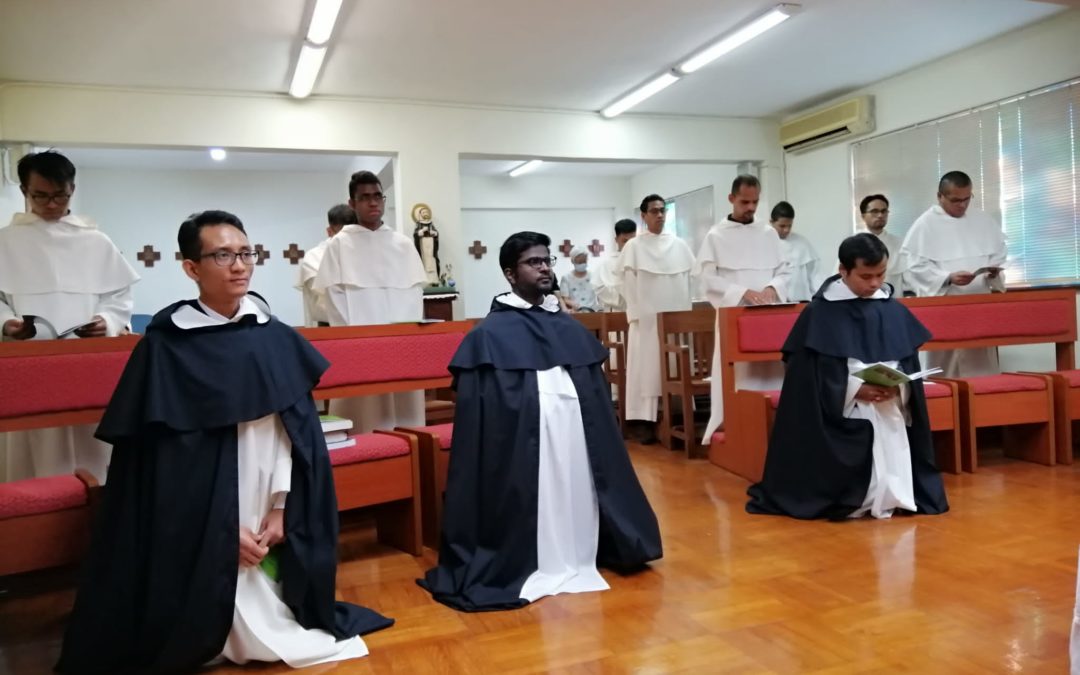
On July 25, 2021, the three Dominican Brothers Richard HTOO, Gabriel Robinson KYAW KO KO and Justin SAW KAUNG HBOWN MYINT, made their solemn religious profession into the Order of Preachers. They had just finished their institutional studies of Philosophy and Theology at the University of Saint Joseph in Macau.
By making their solemn profession, our three brothers culminated a five-year-long process of formation, counting from the moment they completed their Novitiate, in July 2016. It was on that day when they made their first simple (temporary) religious profession, taking upon themselves the three evangelical counsels of poverty, chastity, and obedience to God, to the Blessed Virgin Mary, and St Dominic, the founder of the Dominican Order. Now, after five years, they did the same until death: A sort of matrimonial covenant with God, the religious profession seen in spousal terms. The ceremony of the religious profession takes place normally within the Mass. At the end of the proclamation of the Gospel, the brothers are called by their names and asked to affirm their willingness to live according to the evangelical counsels. Then, one by one, the brothers kneel before the altar, place their hands in their Provincial hands atop the Book of Constitutions of the Order of Preachers, and pronounce the formula of the profession.
In our missionary Province of Our Lady of the Rosary, with an additional promise, namely, to go to Missio ad gentes, if so decided by their Superiors. In the formula of profession used in the Dominican Order, only the evangelical counsel of obedience is mentioned. Everything else, even the other two vows of poverty and chastity, is included there, as the Book of Constitutions of the Friar Preachers explains: By obedience, a person dedicates himself totally to God, and his actions approximate to the goal of the profession, which is the perfection of charity. Everything else too in the apostolic life is included under obedience (LCO, 19). The act of obedience, in which one gives his entire self in service to God, is what brings unity to a brother’s life, and it is what enables him to grow in charity and love. Poverty and chastity go hand in hand with obedience.
In the Dominican culture, a life of evangelical poverty frees the friar of the desire for material wealth. Furthermore, it allows a brother to grow in his dependence on the Lord and his trust in God’s providence and care. Likewise, a life of chastity is manifested through religious celibacy. It enables a friar to devote himself ceaselessly to preaching and to the proclamation of the Gospel for the salvation of souls without the responsibilities of married family life. In addition, they support themselves in this endeavor, through a fraternal life in common, working, praying, and studying together.
Through the solemn religious profession, a brother acquires certain responsibilities, like voting rights in the community Chapter and the capacity to serve in different offices. More importantly though, complete, permanent religious consecration allows the brothers to be dedicated to God, who is supremely loved, and to seek the perfection of charity in the service of God Kingdom, for the honor of God, the building up of the Church and the salvation of the world (c. 573). Our sincerest congratulations to the three solemnly professed brothers!
Journeying Together as Dominicans
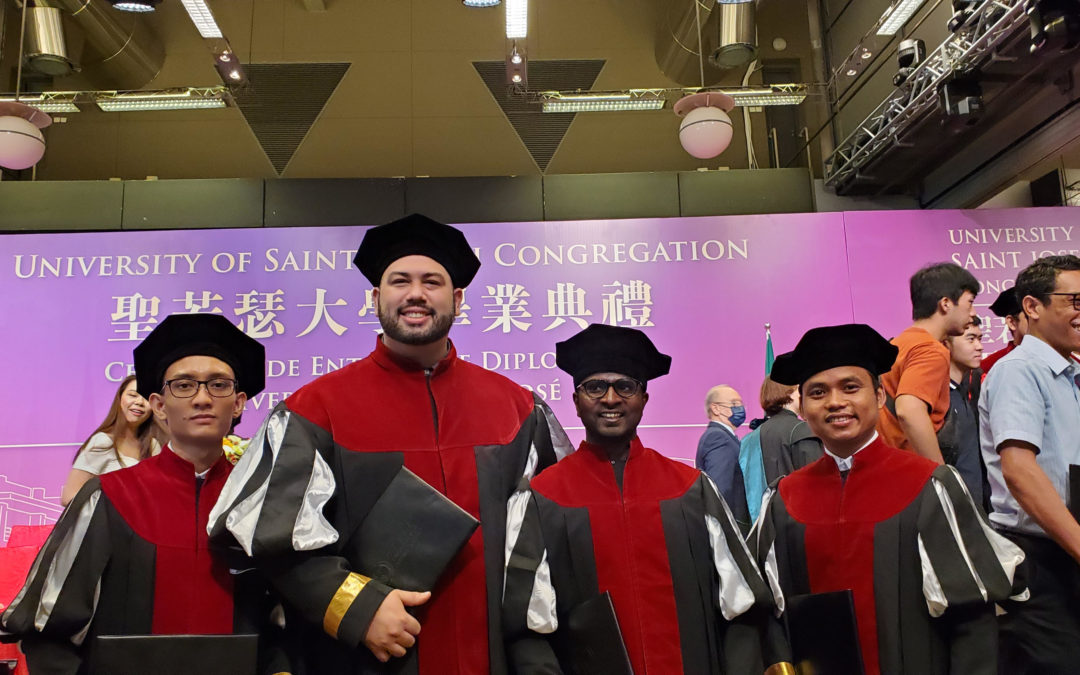
Life is a journey! Student life is a journey! Religious life is a journey, too, indeed a unique or distinctive journey! Being both students and religious, graduation is quite an experience for us journeying together.
There is a saying, “if you want to walk fast, walk alone. However, if you want to walk far, walk with others.†I am convinced that this saying is particularly suitable for religious life, in which fraternal life is lived in the community. The strength of being in a religious community is to help one another when one is not in the right condition physically, spiritually, or intellectually. There is no room in it for individualistic approaches. He who is a religious community pursues his own interests and projects without being sensitive to others may perhaps achieve them, but he will not find anyone beside him to celebrate it together or to share his joy with.
Celebration never takes place in solitude. It occurs only in the community, as it is a joy to be shared.
As a Dominican, journeying together with one’s own community is something essential because community life is one of the four pillars of Dominican spirituality.  Accomplishing something together with others makes it truly enjoyable and meaningful since such joy is to be shared. That is the case with the group of Dominican brothers who this year graduate after five years of study in USJ.
We give thanks to the Lord for His many blessings bestowed on us throughout these years.
And we thank our fellow Dominicans [and the USJ academic community] with whom we journey together.
Author. Gabriel Kyaw Ko Ko, OP
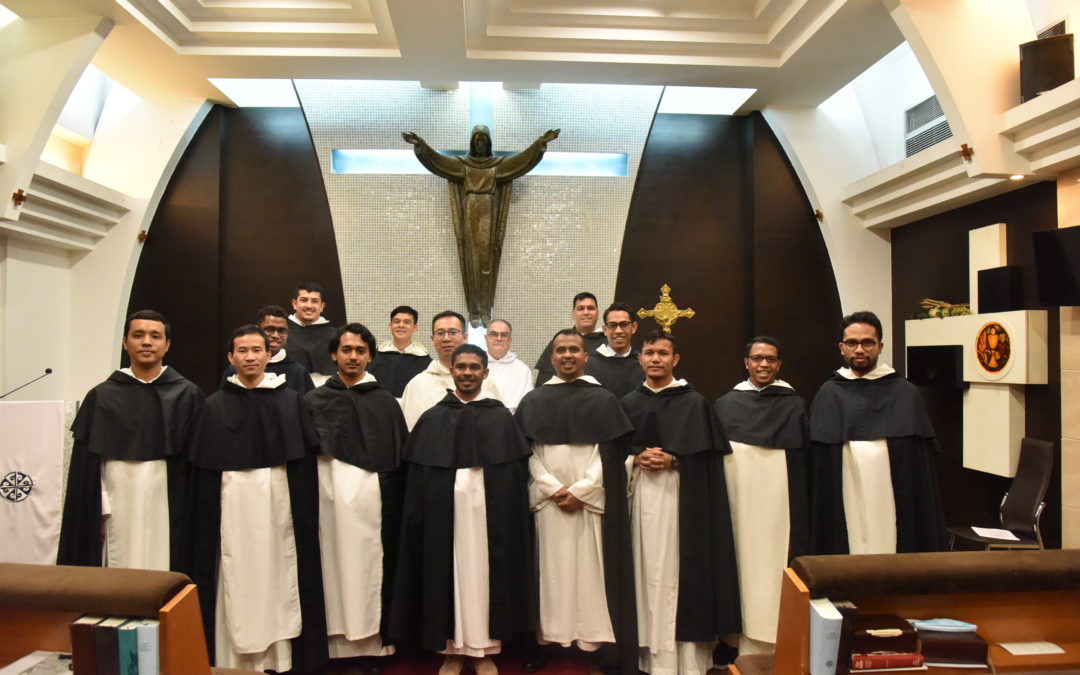
On 21 June 2021, a group of 13 Dominican Student Brothers had their profession renewal in Macau. They promised obedience, chastity, and poverty to God, although only one of the three evangelical counsels Obedience is mentioned in the Dominican Order. This event has brought home to my mind a few thoughts that I wish to share in these lines.
Promising obedience to God means submitting ourselves to Him, listening to Him. In fact, the word “obedience [from the Latin ob-audire] means, in the theological reflection, listening. Listening to God is a way to express our intimate relationship with Him who has spoken and keeps calling to each of us through our hearts and minds. The Lord has called to follow Him in a special way; that is why we name it vocation and it is a privilege, a divine gift.
In promising obedience to God, we do not lose our freedom; rather we regain it! Why? Because we say yes to Him freely, without force or fear. Truly, there are renunciations in it, like other people (for instance, in marriage, in social duties) or like in the case of Jesus, who sought the will of his Father as the food who nourished his life; even in the difficult moments of the cross, he kept bedient until death seeing in such obedience a loving gift. Our religious renunciation does not mean losing our freedom? On the contrary, in the Christian understanding, religious obedience to God implies an intimate relationship with God.
God calls us since we were born: You did not choose me but I chose you (John 15:16); each of us has received from birth a special gift from God. He already knew what we were going to be in the future, while we when we are only dreaming to become someone as we grow old. Our parents may choose to have us, but they cannot choose what we are to be.
So, our Profession Renewal or Vows renewal simply means looking forward to our solemn profession, which is made until death. Religious life is a radical following of Jesus’ poor, chaste, and obedient. All things were done by Jesus according to His Father’s will. In the Garden of Gethsemane, His obedience was demonstrated by His acceptance of the cup of suffering. Throughout the Gospels, Jesus seeks the will of His Father in prayer. Obeying for him did not mean submission to tyrannical power, as it is the connotation in contemporary society. Obedience for Jesus was really an act of trust in His Father. Proportionally in our case, when we obey our religious superiors do so because we trust that, as legitimate authorities, they have our best interests at heart – leading us to what we could not or would not otherwise pick by ourselves.
For instance; I may be unwilling to obey traffic laws, but I trust they exist to protect me and people. This statement is indeed true because, in my driving, I could be so selfishly speeding toward my destination that I might not think of the safety of other people. To remind me that this should not be the case, the trusted authorities enact laws. In the same way, Jesus obedience was an expression of love and active trust. It is exactly the same love and trust that the religious profess when taking their solemn vow of obedience. Indeed, their vow of obedience is really a vow of trust in God first and foremost, even if they promise it also to their constituted religious superiors. The freedom they have regained is their full dedication to God’s service.
Bro. Cesar De Sousa OP.
General Situation
On the 1st of February, the Myanmar military staged the coup and took political power. On that same day, the military detained the top government officials including President U Win Myint, State Counselor Daw Aung San Suu Kyi, and other political activists. Days after the coup, people poured into the streets and protested peacefully against the junta. As days passed, the anti-coup protest gained momentum and became larger and larger. In cracking down the protesters, the junta coup initially used water cannons and rubber bullets, and arrested whoever they could catch on the streets but seeing that people do not fear their suppression, they began to use live ammunition.
The first protestor to be shot in the head by live ammunition was Ma Mya Thwae Thwae Khaing, 20, from Nay Pyi Daw, capital of the country on the 9th of February. After the shooting of this young lady, the anti-coup protest even grew stronger and larger. To terrorize and silence the protestors, the military coup began to kill, torture, and arrested more people. However, the protest did not wane. As the military forces were becoming more violent in whatever they did, people began to build blocks or barriers in their quarters in order to prevent the military from entering and arresting them. But the military and police forces would burn those barricades, shoot, and arrest and torture everyone they could find on the streets. In some cases, the coup forces would even shoot to the houses from the streets, destroying the private properties, cars, and burning shops. In more extreme cases, the forces shot the passing by civilians on the streets and raided the houses at night shooting the family members including children, and looting the properties of the families.
The protest may have decreased in scale, but the people would still show their repugnance for the coup in every way possible. As the protest continues days and nights in all forms, people are being killed daily in every part of the country. The 27th of March, Armed Forces Day was the bloodiest day so far with at least 114 civilians reported dead by local news services. As of 30 March, (521) people were confirmed killed by this junta coup. The death toll could have risen much higher by now. The Assistance Association for Political Prisoners (AAPP) has compiled and documented a total of (2608) people being detained in relation to the attempted military coup.
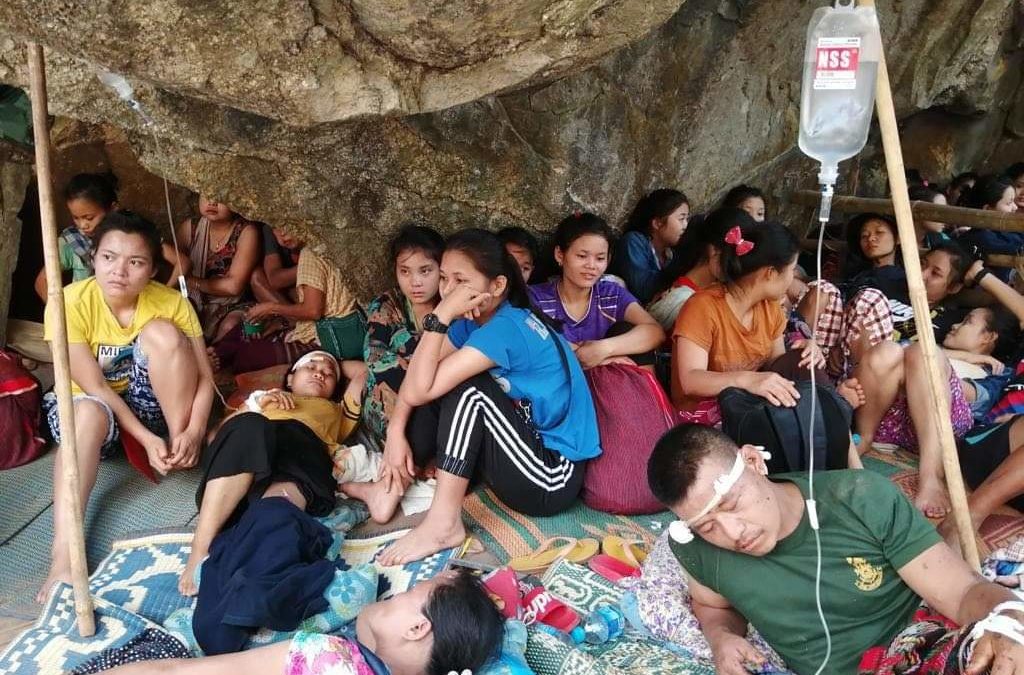
In the latest escalating conflict, the military armed forces set fires on the residential houses in Mandalay in the early mornings of 30th and 31st of March and as a result, around 500 families are now homeless and are in dire need of help. Civil war is also escalating in the ethnic armed groups’ controlled areas. As the coup forces are losing outposts to the ethnic armed groups, they used fighter jets to launch airstrikes and shelled mortars into the villages, killing some civilians and injuring many others. Fearing airstrikes, thousands of villagers fled and crossed the Salween River and sought refuge in Thailand but they were forced to return to the Myanmar side by the Thai authorities. As it is not safe to return to their villages, the villagers are now hiding in the forest under the protection of rocks.
In the coming weeks, the situation could still get worse because more ethnic armed groups are said to be preparing for civil war. The civilians and ethnic armed groups are determined to eliminate the military from the political scene. Therefore, all will fight against this common enemy. Many people are in border areas are starting to dig holes in their backyards in case of war while the people in town start to defend themselves by making home weapons.
The situation of the Friars
Yangon: St. Dominic’s house is located in the neighborhood of the retired officials and therefore, it is relatively safe and peaceful there. Unless ill-hearted informers spread rumors about our brothers there, there is no real danger of being raided. However, Shwe Pyi Thar Parish, the parish that we are taking care of, is in the conflict area. Some parishioners were arrested and killed weeks ago. As garment factories were either burned or closed down, many parishioners are now out of work. With the help of some medical volunteers, Fr. Paul visited the affected areas and gave material and spiritual assistance to them. The donation received from Hong Kong has been handed over to Fr. Paul for the relief of his parishioners. The military forces patrol and lurk around the church campus every night that Fr. Paul and his workers have to be always watchful.
Loikaw: The brothers in Loikaw are relatively safe as well. The community is not so far from infantry and artillery. Those two units of the military are in our parish territory. Though the armies have not done any physical harm to the public, they regularly patrol in their trucks on the streets in the evening and terrorize the people by throwing sound bombs (stun grenade), shooting into the air, and giving warnings to stay indoors. If the ethnic armed groups come to attack those military forces, there might be a danger for the Friars. There is also a possibility that they raid the community, because seeing the buildings, they might think that we have money. The brothers are always on the watch.
Mandalay: The brothers in Mandalay are safe. The community is 40 minutes drive from the center of Mandalay. In Sint Kaing Township, only two protestors have been killed. Compared to other places, the protest here is not so robust and the people are not united. Those who want to protest do not dare to do it actively because there are spies everywhere. As a result, the protest died down easily. The military forces have raided some villages for protesting. However, Zaw Gyi, in which the brothers live, is surrounded by other villages that it seems the coup forces do not dare to come. However, everyone in the village is terrified and always watchful.
Fr. Moses Dereh, OP
Vicar of the Provincial for the mission in Myanmar
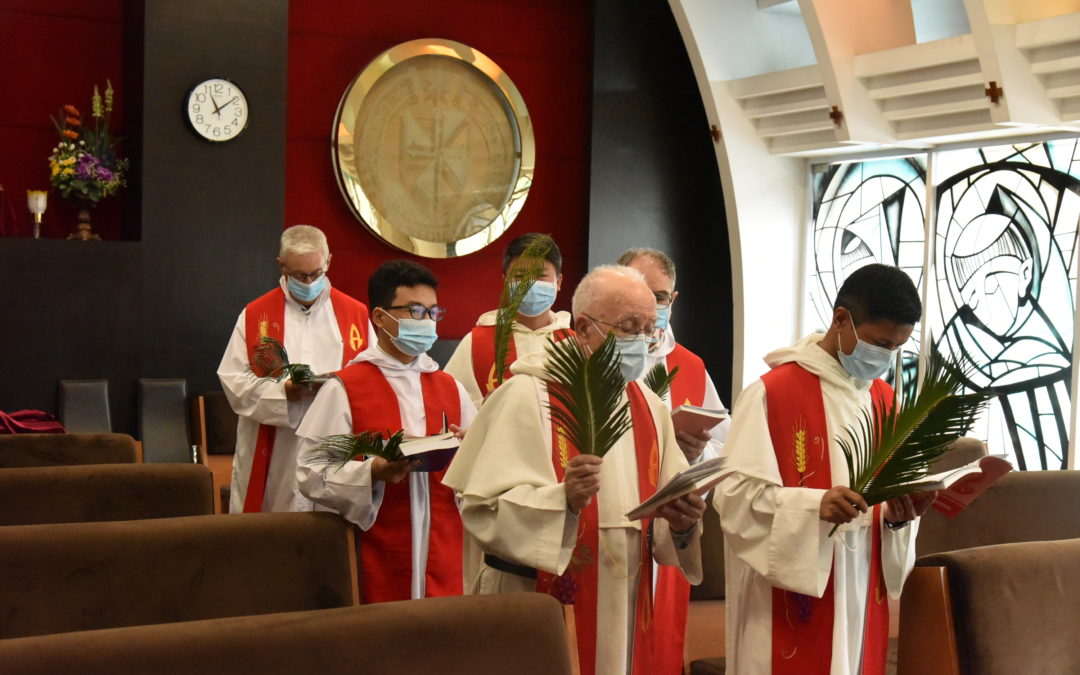
Palm Sunday Gospel: “Let us reflect on the Cross of Jesus”
Palm Sunday allows us the continuous reading of two chapters of the Gospel of Mark. Being objective, the joy of the disciples is put to the test by the story of the suffering, condemnation, and death of our Lord Jesus.
Remember that the Gospel of Mark addresses the communities that had suffered persecution under Nero and, as a logical consequence, many denied their faith and abandoned it. Others, despite the danger and their own insecurities, resisted the persecution and persevered without seeing immediate favorable results.
The Gospel portrays these characters and their decisions, their leaps of faith, and their frustrations. Thus we see a woman who, ignoring the comments against her, pours a bottle of perfume on Jesus, anointing him, that is, preparing him for his destiny. But not all the disciples understood the mission of Jesus as the woman. Judas Iscariot, sitting at the table, sells and betrays his Master. We have Peter, who despite promising that he would give his life for his Lord, at the moment when he had to, denies it and abandons him.
So varied are the reactions of the disciples that it would be useful to read carefully and slowly this Gospel to contemplate the scenes, identify with the sadness of the disciples, understand the fear and helplessness of some, the courage and faith of others. Our journey of faith, like the disciples, is likely to be plagued with fear and shame, or with hope and trust in the Lord despite adversity.
Palm Sunday invites us to react to the cross of Jesus because it, hides the greatest hope of all time.