Solemnity of Saint Dominic: 8 August, 2021
Get the PDF Article from the official website of the Order of Preachers
Get the PDF Article from the official website of the Order of Preachers
Get the PDF click link Article Pope Francis’s Letter address to the Master of the Order of Preachers on the eight hundred anniversary of Sait Dominic’s death.
Homily of Master of the Order of Preachers: click on the link below
https://www.dominicansmacau.org/wp-content/uploads/2021/08/Homily_Dies-Natalis_2021.EN_.pdf
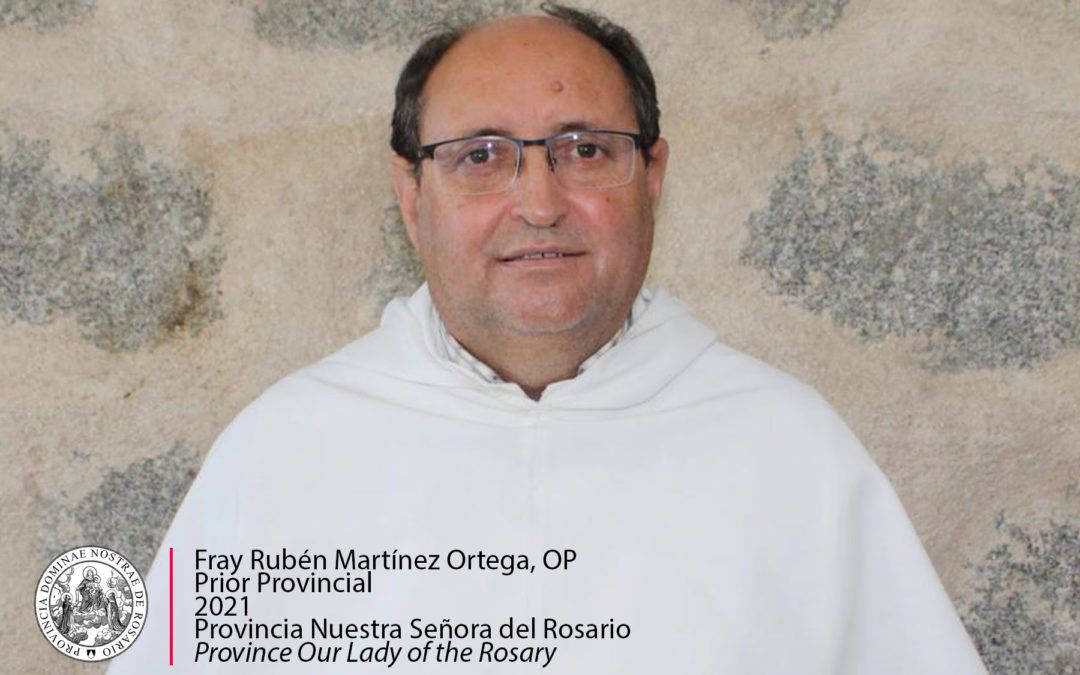
Father Ruben Martínez Ortega OP was elected as a Prior Provincial of Our Lady of the Rosary Province on August 5, 2021, in Avila, Spain. He is the successor of Fr Bonifacio García Solís OP, and the 116 Prior Provincial of the Province.
Fr Rubén was born on 23 August 1962 in Mazariegos, (Palencia, Spain). He completed his High School studies at Colegio Nuestra Señora del Rosario in Valladolid (1972-1980). He entered the novitiate at Santo Domingo Priory of Ocaña (Toledo, Spain) (1981-1982), and made his first vows on 21 September 1982. He completed his institutional studies at the Provincial Studium of San Pedro Mártir, in Madrid, from 1980 to 1987. On 27 June 1987, he was ordained to the priesthood.
He studied English in Scotland before returning to Spain to fulfill his military service from 1988 to 1989. Then he was assigned to the mission of Taiwan (1989 -2013) and to Timor Leste (2013-2021) .
While in the Mission of Taiwan, aside from his pastoral ministries in various Taiwanese-speaking parishes, he served as Vicar Provincial of the Mission from 2001 to 2010 and as the National Coordinator of the Dominican Family in Taiwan.
In 2013 Fr Ruben was chosen to be one of the founding friars of the Timor Leste mission, and he served there as the Vicar of the Provincial and the superior at Saint Dominic’s House in Dili. Although his native language is Spanish, he also speaks fluently English, Taiwanese, Portuguese, and Tetun.
Father Ruben was elected by the capitulars of the Provincial Chapter gathered in the Real Monasterio Santo Tomas, in Avila, on 5 August 2021; and his election was confirmed by the Master of the Order of Preacher, Fr Gerard Francisco Timoner III, OP.
It is with great joy that the brethren in the Province of Our Lady of the Rosary welcome the new Prior Provincial and we fervently ask God to send His Holy Spirit upon him to guide him in animating the brothers to be faithful to the Gospel.
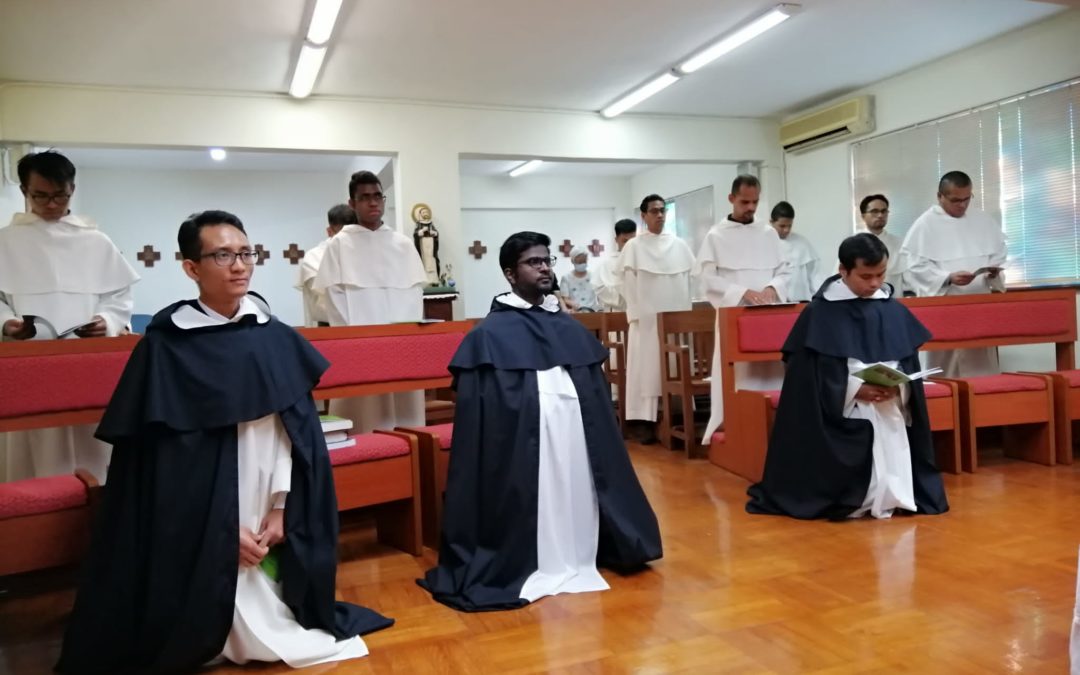
On July 25, 2021, the three Dominican Brothers Richard HTOO, Gabriel Robinson KYAW KO KO and Justin SAW KAUNG HBOWN MYINT, made their solemn religious profession into the Order of Preachers. They had just finished their institutional studies of Philosophy and Theology at the University of Saint Joseph in Macau.
By making their solemn profession, our three brothers culminated a five-year-long process of formation, counting from the moment they completed their Novitiate, in July 2016. It was on that day when they made their first simple (temporary) religious profession, taking upon themselves the three evangelical counsels of poverty, chastity, and obedience to God, to the Blessed Virgin Mary, and St Dominic, the founder of the Dominican Order. Now, after five years, they did the same until death: A sort of matrimonial covenant with God, the religious profession seen in spousal terms. The ceremony of the religious profession takes place normally within the Mass. At the end of the proclamation of the Gospel, the brothers are called by their names and asked to affirm their willingness to live according to the evangelical counsels. Then, one by one, the brothers kneel before the altar, place their hands in their Provincial hands atop the Book of Constitutions of the Order of Preachers, and pronounce the formula of the profession.
In our missionary Province of Our Lady of the Rosary, with an additional promise, namely, to go to Missio ad gentes, if so decided by their Superiors. In the formula of profession used in the Dominican Order, only the evangelical counsel of obedience is mentioned. Everything else, even the other two vows of poverty and chastity, is included there, as the Book of Constitutions of the Friar Preachers explains: By obedience, a person dedicates himself totally to God, and his actions approximate to the goal of the profession, which is the perfection of charity. Everything else too in the apostolic life is included under obedience (LCO, 19). The act of obedience, in which one gives his entire self in service to God, is what brings unity to a brother’s life, and it is what enables him to grow in charity and love. Poverty and chastity go hand in hand with obedience.
In the Dominican culture, a life of evangelical poverty frees the friar of the desire for material wealth. Furthermore, it allows a brother to grow in his dependence on the Lord and his trust in God’s providence and care. Likewise, a life of chastity is manifested through religious celibacy. It enables a friar to devote himself ceaselessly to preaching and to the proclamation of the Gospel for the salvation of souls without the responsibilities of married family life. In addition, they support themselves in this endeavor, through a fraternal life in common, working, praying, and studying together.
Through the solemn religious profession, a brother acquires certain responsibilities, like voting rights in the community Chapter and the capacity to serve in different offices. More importantly though, complete, permanent religious consecration allows the brothers to be dedicated to God, who is supremely loved, and to seek the perfection of charity in the service of God Kingdom, for the honor of God, the building up of the Church and the salvation of the world (c. 573). Our sincerest congratulations to the three solemnly professed brothers!
Journeying Together as Dominicans
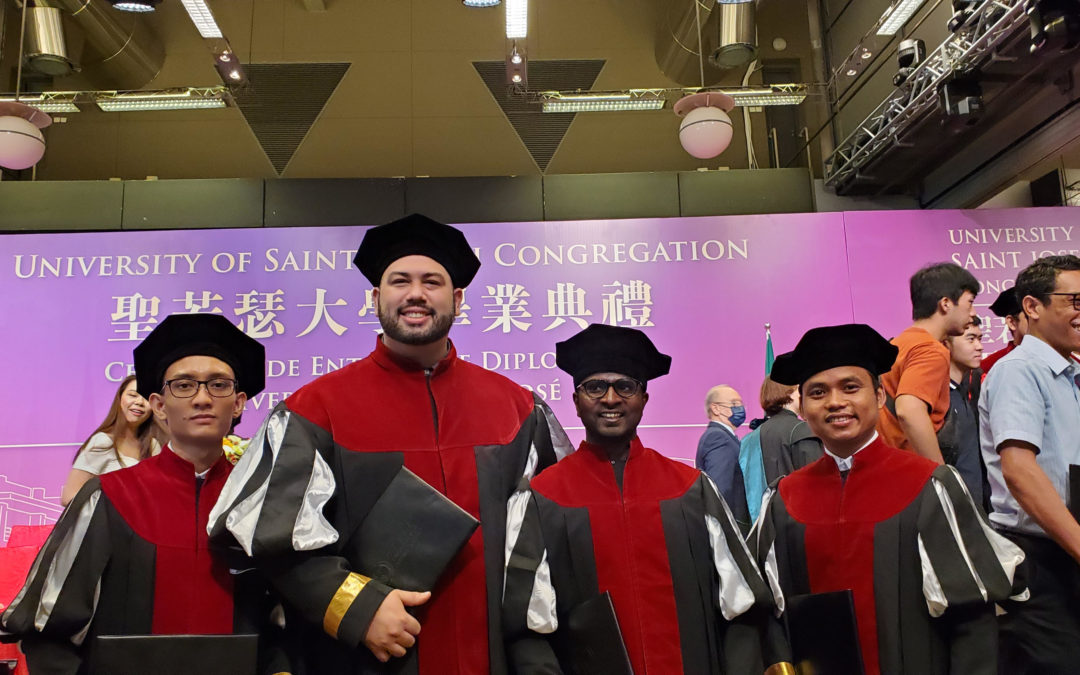
Life is a journey! Student life is a journey! Religious life is a journey, too, indeed a unique or distinctive journey! Being both students and religious, graduation is quite an experience for us journeying together.
There is a saying, “if you want to walk fast, walk alone. However, if you want to walk far, walk with others.†I am convinced that this saying is particularly suitable for religious life, in which fraternal life is lived in the community. The strength of being in a religious community is to help one another when one is not in the right condition physically, spiritually, or intellectually. There is no room in it for individualistic approaches. He who is a religious community pursues his own interests and projects without being sensitive to others may perhaps achieve them, but he will not find anyone beside him to celebrate it together or to share his joy with.
Celebration never takes place in solitude. It occurs only in the community, as it is a joy to be shared.
As a Dominican, journeying together with one’s own community is something essential because community life is one of the four pillars of Dominican spirituality.  Accomplishing something together with others makes it truly enjoyable and meaningful since such joy is to be shared. That is the case with the group of Dominican brothers who this year graduate after five years of study in USJ.
We give thanks to the Lord for His many blessings bestowed on us throughout these years.
And we thank our fellow Dominicans [and the USJ academic community] with whom we journey together.
Author. Gabriel Kyaw Ko Ko, OP