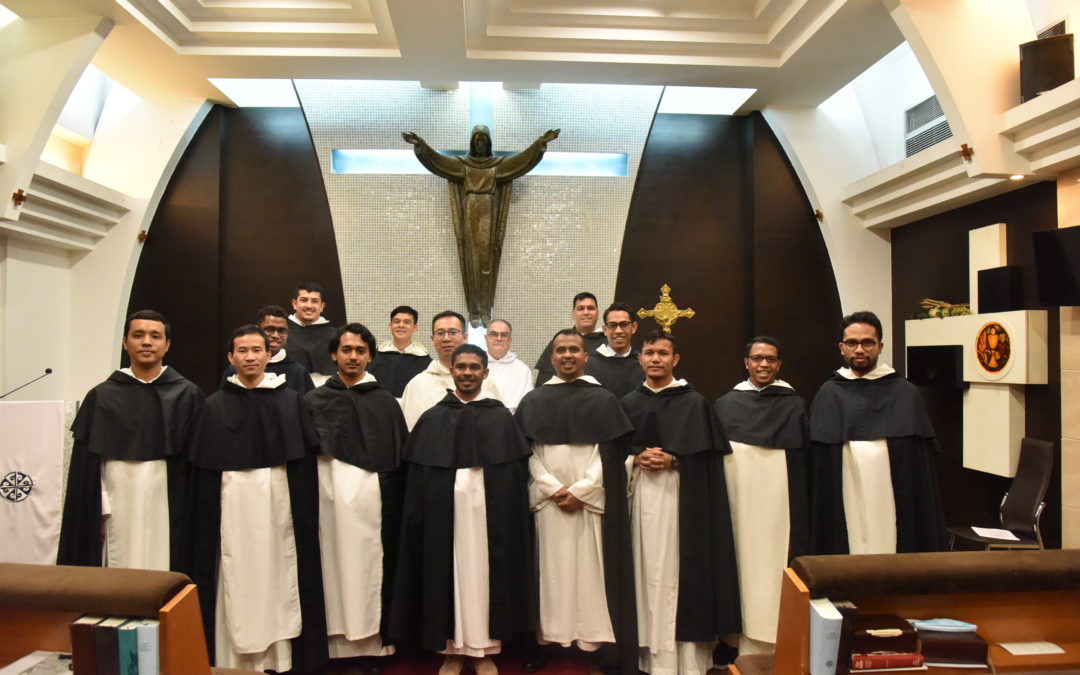
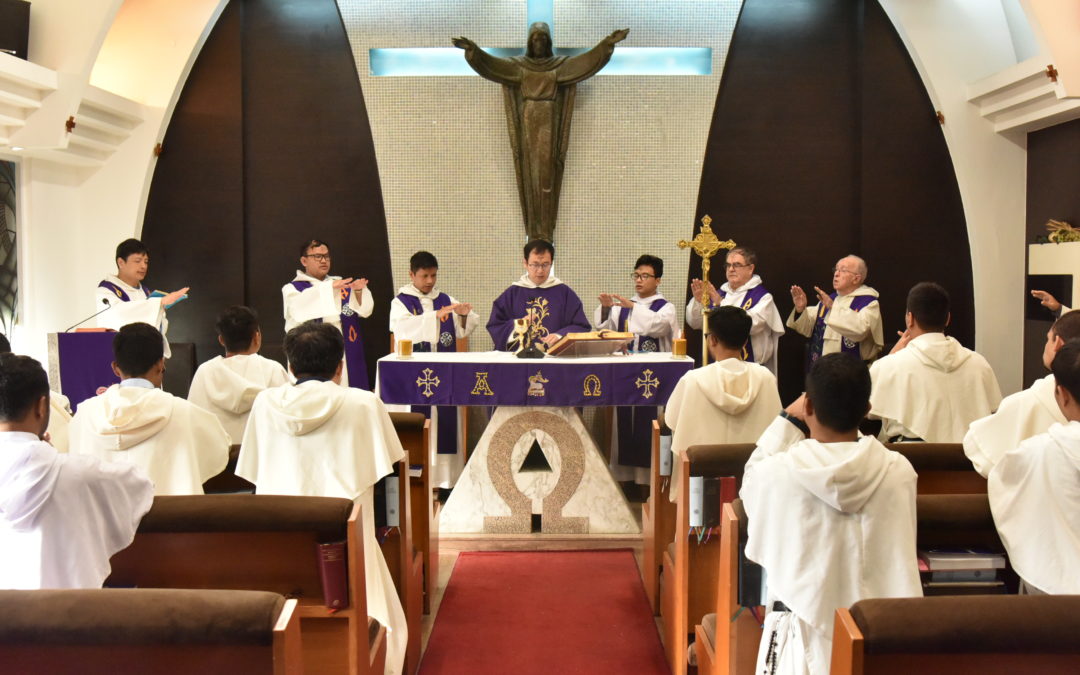
On 21 June 2021, a group of 13 Dominican Student Brothers had their profession renewal in Macau. They promised obedience, chastity, and poverty to God, although only one of the three evangelical counsels Obedience is mentioned in the Dominican Order. This event has brought home to my mind a few thoughts that I wish to share in these lines.
Promising obedience to God means submitting ourselves to Him, listening to Him. In fact, the word “obedience [from the Latin ob-audire] means, in the theological reflection, listening. Listening to God is a way to express our intimate relationship with Him who has spoken and keeps calling to each of us through our hearts and minds. The Lord has called to follow Him in a special way; that is why we name it vocation and it is a privilege, a divine gift.
In promising obedience to God, we do not lose our freedom; rather we regain it! Why? Because we say yes to Him freely, without force or fear. Truly, there are renunciations in it, like other people (for instance, in marriage, in social duties) or like in the case of Jesus, who sought the will of his Father as the food who nourished his life; even in the difficult moments of the cross, he kept bedient until death seeing in such obedience a loving gift. Our religious renunciation does not mean losing our freedom? On the contrary, in the Christian understanding, religious obedience to God implies an intimate relationship with God.
God calls us since we were born: You did not choose me but I chose you (John 15:16); each of us has received from birth a special gift from God. He already knew what we were going to be in the future, while we when we are only dreaming to become someone as we grow old. Our parents may choose to have us, but they cannot choose what we are to be.
So, our Profession Renewal or Vows renewal simply means looking forward to our solemn profession, which is made until death. Religious life is a radical following of Jesus’ poor, chaste, and obedient. All things were done by Jesus according to His Father’s will. In the Garden of Gethsemane, His obedience was demonstrated by His acceptance of the cup of suffering. Throughout the Gospels, Jesus seeks the will of His Father in prayer. Obeying for him did not mean submission to tyrannical power, as it is the connotation in contemporary society. Obedience for Jesus was really an act of trust in His Father. Proportionally in our case, when we obey our religious superiors do so because we trust that, as legitimate authorities, they have our best interests at heart – leading us to what we could not or would not otherwise pick by ourselves.
For instance; I may be unwilling to obey traffic laws, but I trust they exist to protect me and people. This statement is indeed true because, in my driving, I could be so selfishly speeding toward my destination that I might not think of the safety of other people. To remind me that this should not be the case, the trusted authorities enact laws. In the same way, Jesus obedience was an expression of love and active trust. It is exactly the same love and trust that the religious profess when taking their solemn vow of obedience. Indeed, their vow of obedience is really a vow of trust in God first and foremost, even if they promise it also to their constituted religious superiors. The freedom they have regained is their full dedication to God’s service.
Bro. Cesar De Sousa OP.
General Situation
On the 1st of February, the Myanmar military staged the coup and took political power. On that same day, the military detained the top government officials including President U Win Myint, State Counselor Daw Aung San Suu Kyi, and other political activists. Days after the coup, people poured into the streets and protested peacefully against the junta. As days passed, the anti-coup protest gained momentum and became larger and larger. In cracking down the protesters, the junta coup initially used water cannons and rubber bullets, and arrested whoever they could catch on the streets but seeing that people do not fear their suppression, they began to use live ammunition.
The first protestor to be shot in the head by live ammunition was Ma Mya Thwae Thwae Khaing, 20, from Nay Pyi Daw, capital of the country on the 9th of February. After the shooting of this young lady, the anti-coup protest even grew stronger and larger. To terrorize and silence the protestors, the military coup began to kill, torture, and arrested more people. However, the protest did not wane. As the military forces were becoming more violent in whatever they did, people began to build blocks or barriers in their quarters in order to prevent the military from entering and arresting them. But the military and police forces would burn those barricades, shoot, and arrest and torture everyone they could find on the streets. In some cases, the coup forces would even shoot to the houses from the streets, destroying the private properties, cars, and burning shops. In more extreme cases, the forces shot the passing by civilians on the streets and raided the houses at night shooting the family members including children, and looting the properties of the families.
The protest may have decreased in scale, but the people would still show their repugnance for the coup in every way possible. As the protest continues days and nights in all forms, people are being killed daily in every part of the country. The 27th of March, Armed Forces Day was the bloodiest day so far with at least 114 civilians reported dead by local news services. As of 30 March, (521) people were confirmed killed by this junta coup. The death toll could have risen much higher by now. The Assistance Association for Political Prisoners (AAPP) has compiled and documented a total of (2608) people being detained in relation to the attempted military coup.
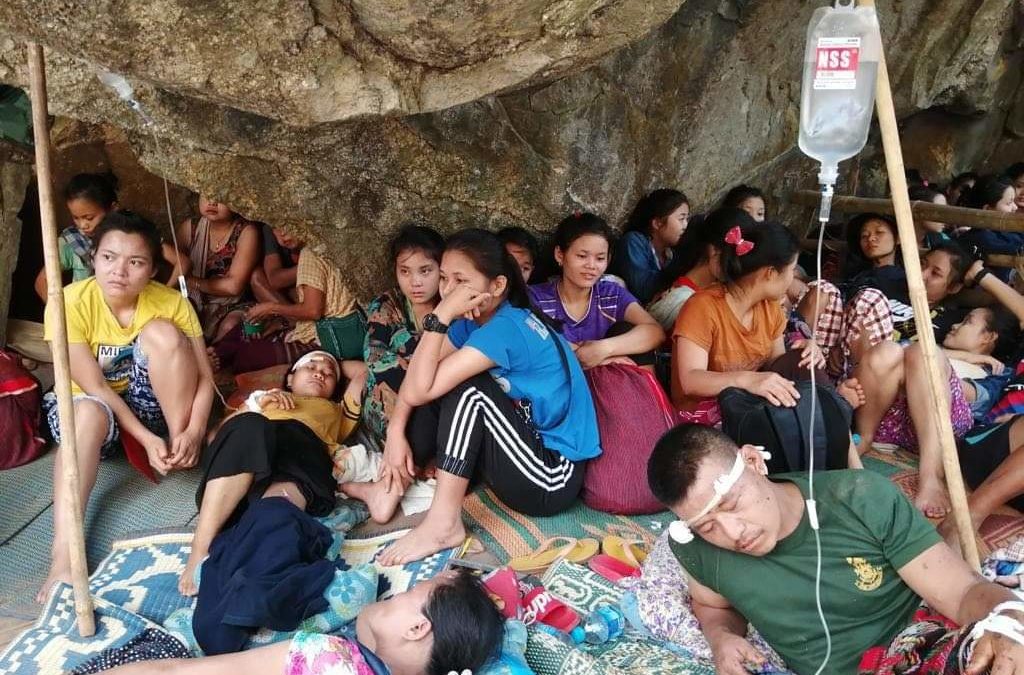
In the latest escalating conflict, the military armed forces set fires on the residential houses in Mandalay in the early mornings of 30th and 31st of March and as a result, around 500 families are now homeless and are in dire need of help. Civil war is also escalating in the ethnic armed groups’ controlled areas. As the coup forces are losing outposts to the ethnic armed groups, they used fighter jets to launch airstrikes and shelled mortars into the villages, killing some civilians and injuring many others. Fearing airstrikes, thousands of villagers fled and crossed the Salween River and sought refuge in Thailand but they were forced to return to the Myanmar side by the Thai authorities. As it is not safe to return to their villages, the villagers are now hiding in the forest under the protection of rocks.
In the coming weeks, the situation could still get worse because more ethnic armed groups are said to be preparing for civil war. The civilians and ethnic armed groups are determined to eliminate the military from the political scene. Therefore, all will fight against this common enemy. Many people are in border areas are starting to dig holes in their backyards in case of war while the people in town start to defend themselves by making home weapons.
The situation of the Friars
Yangon: St. Dominic’s house is located in the neighborhood of the retired officials and therefore, it is relatively safe and peaceful there. Unless ill-hearted informers spread rumors about our brothers there, there is no real danger of being raided. However, Shwe Pyi Thar Parish, the parish that we are taking care of, is in the conflict area. Some parishioners were arrested and killed weeks ago. As garment factories were either burned or closed down, many parishioners are now out of work. With the help of some medical volunteers, Fr. Paul visited the affected areas and gave material and spiritual assistance to them. The donation received from Hong Kong has been handed over to Fr. Paul for the relief of his parishioners. The military forces patrol and lurk around the church campus every night that Fr. Paul and his workers have to be always watchful.
Loikaw: The brothers in Loikaw are relatively safe as well. The community is not so far from infantry and artillery. Those two units of the military are in our parish territory. Though the armies have not done any physical harm to the public, they regularly patrol in their trucks on the streets in the evening and terrorize the people by throwing sound bombs (stun grenade), shooting into the air, and giving warnings to stay indoors. If the ethnic armed groups come to attack those military forces, there might be a danger for the Friars. There is also a possibility that they raid the community, because seeing the buildings, they might think that we have money. The brothers are always on the watch.
Mandalay: The brothers in Mandalay are safe. The community is 40 minutes drive from the center of Mandalay. In Sint Kaing Township, only two protestors have been killed. Compared to other places, the protest here is not so robust and the people are not united. Those who want to protest do not dare to do it actively because there are spies everywhere. As a result, the protest died down easily. The military forces have raided some villages for protesting. However, Zaw Gyi, in which the brothers live, is surrounded by other villages that it seems the coup forces do not dare to come. However, everyone in the village is terrified and always watchful.
Fr. Moses Dereh, OP
Vicar of the Provincial for the mission in Myanmar
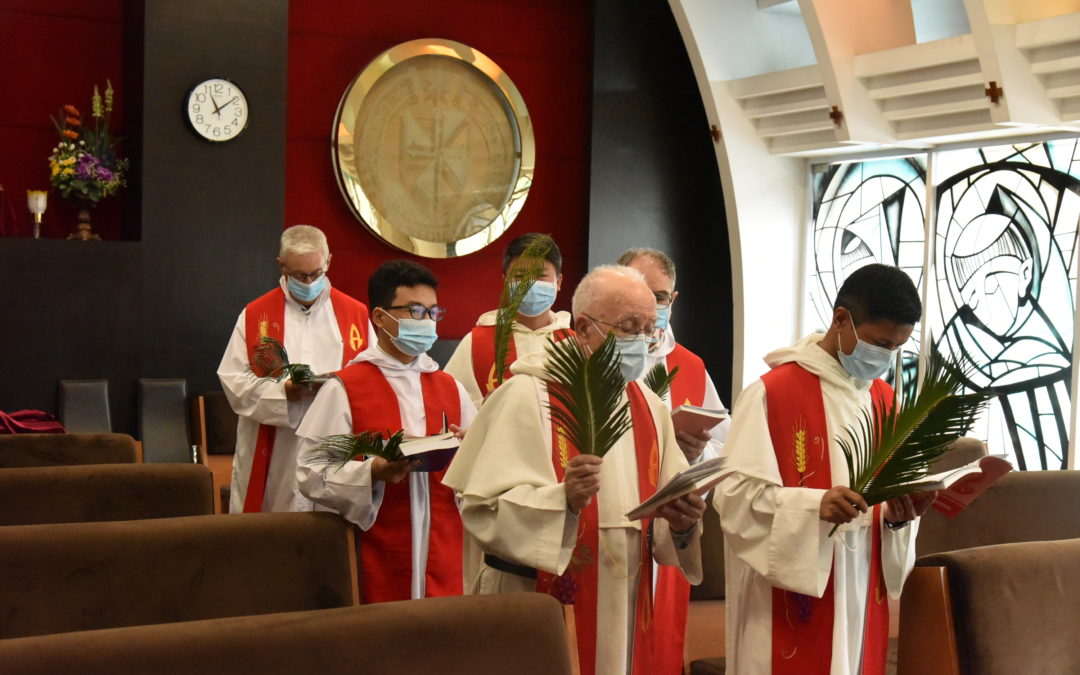
Palm Sunday Gospel: “Let us reflect on the Cross of Jesus”
Palm Sunday allows us the continuous reading of two chapters of the Gospel of Mark. Being objective, the joy of the disciples is put to the test by the story of the suffering, condemnation, and death of our Lord Jesus.
Remember that the Gospel of Mark addresses the communities that had suffered persecution under Nero and, as a logical consequence, many denied their faith and abandoned it. Others, despite the danger and their own insecurities, resisted the persecution and persevered without seeing immediate favorable results.
The Gospel portrays these characters and their decisions, their leaps of faith, and their frustrations. Thus we see a woman who, ignoring the comments against her, pours a bottle of perfume on Jesus, anointing him, that is, preparing him for his destiny. But not all the disciples understood the mission of Jesus as the woman. Judas Iscariot, sitting at the table, sells and betrays his Master. We have Peter, who despite promising that he would give his life for his Lord, at the moment when he had to, denies it and abandons him.
So varied are the reactions of the disciples that it would be useful to read carefully and slowly this Gospel to contemplate the scenes, identify with the sadness of the disciples, understand the fear and helplessness of some, the courage and faith of others. Our journey of faith, like the disciples, is likely to be plagued with fear and shame, or with hope and trust in the Lord despite adversity.
Palm Sunday invites us to react to the cross of Jesus because it, hides the greatest hope of all time.
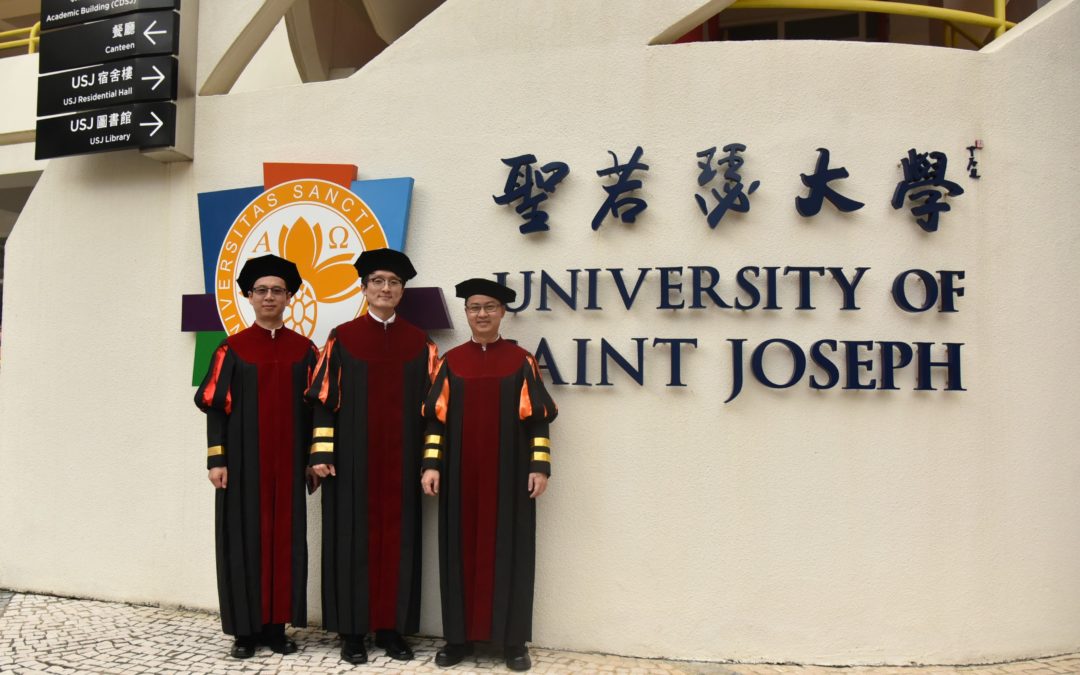
Six of our Brothers graduated from their studies at the University of Saint Joseph, in Macau, last 12th of September 2020. They were the following: our Prior, Fr Paul Fan (Bachelor Business Administration), Fr Ignatius Ngo Van (Master in Education), Brothers Stephen Saw Lej, Marko Thoe Reh, and Francis Bu Ling (Bachelor in Philosophy and Theology), and Luke Jeon Seok Hoon (Master in Education). Congratulations to all of them.
The graduation ceremony and the giving of Diplomas were held at the Tower of Macau. It was a solemn, formal, colorful event, with speeches from the Chancellor of the University, the Rector, and the Government representative. Also rounded up by some words of gratitude, on behalf of the Graduates, by one of the Students.
The picturesque note was caused by the safety measures imposed by the current pandemic: On the stage were religious, civil, and academic authorities all dressed up in their gowns and regalia, but with their faces semi-covered with a mask So were the graduating students as they went up to receive their diplomas. No choice, no exception, it was protocol; the only choice allowed was the color of the mask, which was not regulated! What will the next generation think when they see those pictures? For sure, they will laugh at their rather comic appearance, only until someone may manage to have to explain to them that in 2020 an invisible guest, in a virus form, managed to leave its mark printed in our faces and in our souls.
Repent and believe in the Gospel
As every good Christian, I have to keep asking myself where do I come from, what is my identity and what is the basis of my belief in Jesus Christ as my Savior.
As I enter our chapel and see the cross in front of the altar, my eyes gaze on Jesus, nailed on it. And I ask myself, “Why had this righteous man die in this painful way?†“If he defended the rights of the people who went astray, then why did have to die on the cross?â€
Searching for an answer, some childhood memories come to my mind. I remember that, as a young boy, once going to school with a friend of mine, along the way, we talked about Jesus. He said to me that Jesus is our Master; that He loved his disciples and taught them many things; and that Jesus teaches us how to imitate him. Furthermore, my friend said that if we wanted to be good students we should also imitate Him…, adding that he had learned those things from the Catechism. At that time I knew nothing about Catechism, so right there in my school, I began to learn Catechism. I enjoyed my classes very much and was interested in learning more and more about Jesus, who was called Master. However, one thing that I never forget in my life is what our Catechist taught us about love: how to love our parents, friends, and neighbors. This was the fruit of those classes focused on love: “Children, you have to love your father and mother and do your duty as a child, and don’t forget to love your friends and neighbor as well.†From those words, I began to understand how much Jesus loves us, and his teaching on “love your neighbor as yourself.â€
Thus, whenever I look at the cross and feel the immeasurable love with which Jesus loves us, I come to understand also that we are human beings, sinners, too weak and limited. And that, even in our sins, He still loves us and saves us. After all, He came into this world to bring us back from sinfulness to righteousness.
John the Baptist, Jesus’ messenger, cried out loudly in the wilderness “Repent and prepare yourselves, the Lord and Savior is near at hand.†Many people believed in his preaching, repented, and were baptized, while many others did not. Jesus came after him and began his ministry with teaching and preaching in the synagogues, calling those who were listening to him to repent from their evil ways and to do good. Through his preaching, many people believed and public sinners repented. But Jesus’ never-ending love went on for those going astray, to the point of giving up his life for his people, accepting death on the cross as a criminal. He accepted this pain out of love, forgiving those who persecuted him and nailed him to the cross: “Father forgives them for they do not know what they do†(Luke 23:34). On that cross, carried on his shoulders on the way to Calvary… we put all our sins.
Jesus is an example for us. He teaches us how to forgive when we are in a bad situation, and to pray for the salvation of all. He made no distinction between Catholics or non-Catholics, Christians or pagans, believers or non-believers. He put us in the same boat; that is why He became truly the Savior of the world.
We say we are sinners yes! But this does not make us lose our faith and trust in Him as our Savior. The covenant that God made with the chosen people of Israel (“I will make you my people and I will be your God†(Jer 30:22)) reaches us, as we are all children of God from the beginning of creation, “created in the image of God†(Gen 1:26-28). This is truly manifest by Jesus Christ who came to save all the people in the world, not just the chosen people.
On Ash Wednesday, as we receive the ashes marked on our foreheads, we are reminded that we are “dustâ€. It is important for us to know our identity as human beings, and to become aware of where we are coming from. God made us equal: we share the same origin and dignity as children of God. Henceforth, we are not to allow any discrimination, racism, hatred, etc., reign among us… White or black skins, different cultures, and countries, these elements complement each other and make the world more beautiful, as we share the same humanity and we are the proudest God’s creatures. God loves us all with the same tenderness, based not in our color, but in the fact of being his children.
Author: Bro. Cesar Lino De Sousa Ximenes OP.
Macao, 17 February 2021
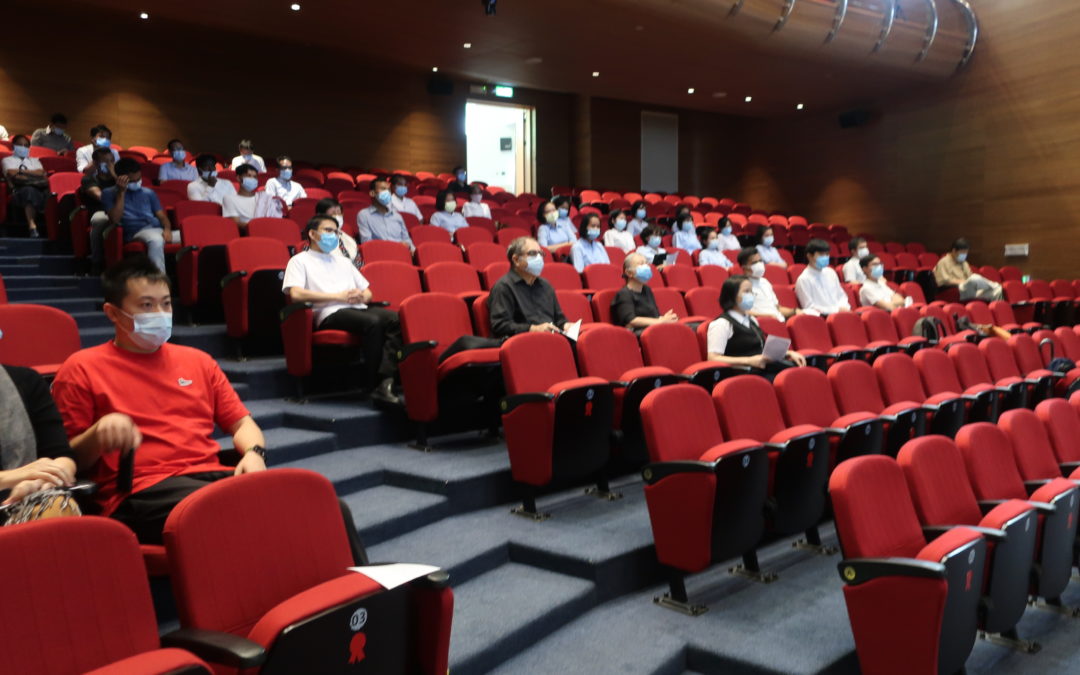
Regular classes in the new Academic Year 2020-2021 at the USJ Faculty of Religious Studies resumed on the 7th of September. Following the Covid-19 regulations (wearing of masks, social distancing, etc.), classes are face-to-face. However, they also cater simultaneously to some 15 enrolled students who, caught abroad (Hong Kong, Taiwan, Philippines, Spain, Italy) without the possibility of traveling to Macau by now, can follow the classes online. Among them are six of our Dominican newly professed brothers who are in Hong Kong.
Two particular activities have taken place during the past few days in this regard. One was the Convocation of Students and Faculty members on the morning of September 14th. The program followed online by our students in Hong Kong, including an address by the Rector of the University; some information by the Dean of the Faculty (Fr Franz Gassner), by the Director of Students Affairs Office (Ms. Teresa Loong), and by the President of Faculty Student Council (Simon Sherman Luk); and a Lecture by Prof. Tyler McNabb entitled Faith and Philosophy with some corollaries applied to the current pandemic situation created by the covid19.
The other was the Opening Mass of USJ in the Holy Cross chapel celebrated by the Chancellor of our University, Bishop Stephen Lee. Very well attended by the Faculty professors (some of them concelebrant priests), administrative staff, and, of course, the students, who had beforehand been tasked to assist at the liturgical celebration as servers, lectors, prayer leaders, and with the music. They did a very good job. The bishop inspiring words in his homily, related to the solemnity of the Exaltation of the Holy Cross, were words of confirmation in our faith in the risen Lord, and of encouragement in the face of challenges
By Fr. Javier Gonzalez Izquierdo OP.