PROVINCIAL CHAPTER  – AVILA 2013
 CHRONICLE NUMBER 10
What is best can also end. Thus today, 3 September, the first part of the Provincial Chapter ends, that is, the study of the Commissions and the discussion of the documents. The second part is still missing which shall be in the hands of the Diffinitors or the eight friars who shall prepare the final text and take determinations on topics which are somewhat reserved.
 the elected diffinitors of the province are:
 Fr. Mariano González MartÃn
 Fr. Tomás Miguel Blázquez
 Fr. Raymond Mi Yuchun
 Fr. Pedro Juan Alonso Merino
 Fr. Ãngel Gabriel Villasmil Bermúdez
 Fr. Emiliano Pérez Peña
 Fr Hyacinthus He Yeosun
 Fr .Mario Jabares Cubillas.
This group shall meet afterwards with the secretariate of a new creation: the inter-diffinitory, that is with the other diffinitor-friars of the three provinces that had also elected their Provincials during this time.
 This was the central theme of our reflection: to see what does it implies on the fact of collaboration and not integration in the one Dominican Province which shall come to pass in the Iberian Peninsula. The Province of Portugal and our Vicariate in Spain are left, as of now, as members who will collaborate but not to join in. The collaboration is already functioning in various areas: preaching, liturgy, the Dominican Family, etc… The members of the JIP (Junta Ibérica de Provinciales) shall be discussing the re-structuring of the Order in Madrid, the preparation of the Jubilee 2016 when the Order celebrates its eighth hundredth anniversary.
The affair is so important for it implied the future, not only the Vicariate of Spain but the structure of the Province of the Rosary. That us why we spoke of a “historical error†if an equivocal decision is taken. It is not a mere sentiment of fidelity or pertenency, but of identity and survival.
We have dedicated a short period in the morning to read an exemplary document. It is a human and theological reflection on Our missionary identity. It is ideal as a prologue of the Acts of the Provincial Chapter. Afterwards the democratic elections thought of by our laws: the diffinitors, the councilors and delegates of the coming General Chapters.
The good also has to end. In one of the chronicles, I alluded an inverse relation between age and possibilities. When age is advanced, there are less possibilities. The third age (aging) is robbing us of the future. It is a grace that the Province of the Rosario still has a future: in Venezuela, in the countries in the Orient. There are Dominican vocations: theirs are the possibilities, theirs is the future.
The chapter has a deep sense of gratitude towards Fr. Javier González Izquierdo. Thankful for the services he had given during as Prior Provincial. And we hope that he would be successful in this new term. Thanks for his work, his simplicity, his intimacy and optimism.
From the elderly, a counsel: I would like to end these informal chronicles with a recognition and a recommendation from my part. Thanks to all those who have supported me, from Avila and from afar, of reading and commenting this page in a daily basis.  This is probably my last chapter.
And a counsel: I would like to remind all those who are working outside of the country of birth some prophetic words: They are not words from a Pontiff nor of a religious Founder, but words of Don Rómulo Gallegos, the author of Doña Bárbara, the best novel of Venezuela. “I am animated to love persons although in the region predominates injustice and barbarity. He tells us more: “There is a good race that loves suffers and hopes.â€When there is love to the people, then all difficulties will be overcome. May God help us to love the people which whom we work.
BenjamÃn GarcÃa Fernández (chronicler and nothing more)
PROVINCIAL CHAPTER – ÃVILA 2013
CHRONICLEÂ Â NUMBER 9
 On Monday, 2 September the work of the chapter resumed. The friars who left to attend the Sundayapostolic commitments came early. The General Assembly tackled a transcendent problem: the fusion of the four Provinces of the Iberian peninsula (The Provinces of Spain, Aragon, Betica and the Rosary). The initials JIP (Junta Iberica de Provinciales) is used.
The fusion is not a caprice but a necessity: the number of friars has dropped drastically and it is imposible to maintain all the ministries and the buildings that still exist till now. In order to seal this fusion, the date was fixed on 2016 when the Order reaches eight hundred years.
In the Province of the Rosary it had decided no to integrate herself but to collaborate. This Province is formed by Vicariates and does not have any territory in Spain: She only has houses of formation. It is a only case within the Order.
The chapters brothers decided to dialogue on this topic within time limit. Only the Vicariate of Spain has a relation with the three Provinces. The vicariates of the Philippines, Japan, Taiwan, Hong Kong and Venezuela will not have any meaning if the Vicariate of Spain separates.
To the six chapter friars from Venezuela, we are happy with the nomination of our Nuncio in Caracas as the Secretary of State of Pope Francis.  The “chavista†government did not help him in any way during his term as the nuncio. He is well trained , thus to face and play with the wild bulls. The Pope during the World Youth Day in Brazil 2013 spoke to the bishops of the challenges the continental (Latin America) has to face. In a similar way, the chapter also marks the path we ought to run, with its challenges and difficulties.
The Asian brothers formed a special commission and understood one antoehr in English.  Their document reflected on the present challenges of the Province.  It is not a juridical document, but a theoretical-realist meditation . It was read, commented and was enriched in the General Assembly. One has to know how to conjugate these three concepts: salvation, preaching and the implantation of the Order.
A question was raised if the young friars who are being ordained are to work in their own countries of origin or they are for the Province, in such a way that they can be assigned to any other place or country. There are Koreans, for example who wished to leave their country. The majority of the chapter brothers preferred the universality of the Province. It is missionary without nationalist limits.
It is proper of the wise to doubt. At the end of the Chapter where so much had been said of the East, of Europe and of Asia, a brother raised a reasonable doubt: “ our mission in Timor, is it in Asia or in Oceania? “
There was also humor masked in technology. In the so called “assisted†Residence  or the Infirmary, there are eight friars, some sickly and others elderly. One of the was impressed when he say a photo of a group of Bishops and Cardinals who came from Rome to greet the Chapter brothers, among them there was a  dwarf and another wearing a winter bonnet. (thanks to Fr. Alejandro Salcedo and his state of the art technology!) Humor is a sign of good health.
BenjamÃn GarcÃa Fernández (chronicler and nothing else)
 PROVINCIAL CHAPTER – ÃVILA 2013
 CHRONICLE NUMBER  8
 30 August, Friday. The chapter continued its rhythm, slow and a little morbid. Some members are surprised by the protagonism of the Venezuelans. They sing the psalms, animate the Eucharist and are not mute in the discussions. Today we discussed about the Promotion of Vocations, and the Academic formation of the young Dominicans. The situations are different according to nationalities. There are young men who call on our convent doors  who are already professionals. Some know English, others have to learn it. To all they are asked for a medical certificate and the will to serve God in the Order. Some of them are asked to produce a baptismal certificate since the whole family is gentile. The Asians are impenetrable, it is not easy to enter into their psychology.
 We feel with great respect before the document on the Government of the Province. The democratic convictions and those that are individualistic clash at times with the vow of obedience. But the outline is well structured, and it was easy to approach it. We are paralyzed when touch the point on poverty. The sensibilities one and other friars are in the antipodes. To be poor in Japan and to be one in Latin America is not the same.  For some friars it is scandalous to travel to Spain every year while for others it is normal. Leaving Japan after a certain period of time is a necessity. To leave the underdeveloped countries is almost a luxury.  The friars are a family, and in the family all are equals.  That is why our laws cannot be distinct for some and for other members.
Brother Ãngel Gabriel appeared today with some monastic garb. Bad sign!  This was proven a few moments later: a headache had sent him to bed. The vile tongues attribute the abrupt malaise to the habit. But it was given by the Masgter of the Order in Croatica. How can this be understood!!
In one of the commissions, in speaking about Asian theology, it loomed in a distance a an original theological and liturgical reflection. Latin America created the theology which it needed: liberation. The inter-religious dialogue with the Asian traditions was seen to be fruitful. But the Spanish friars working there knocked us out: The Christians, the laity and the clerics are almost slaves to the directives and ceremonies from Rome. Obedience and the imitative sense of the Eastern Christian prevailed over creativity.
It is not prohibited to dream. They are commemorating fifty years of the mythical discourse of Martin Luther King: “I have a dreamâ€â€¦ Today there is a Afro-American in the presidency of the United States. In a shorter time we want to see how the Dominicans in Myanmar, Korea, China and Japan do their theology and celebrate their liturgy. They are preparing themselves for that.
In these restless chronicles nothing had been alluded on the Chapter liturgy. There is nothing new under the sun during the Chapter. Some brothers lament there are no Dominican sisters of commited lay women . They are more creative, and discover signs and gestures which men do not occur to us.  Aside from the chanted psalms, some in the traditional “pilgrims’ tune”, the celebrations were imply rituals.
And we as workers of the vineyard of the lord, we have a day and a half of relative vacation. Though we cannot make pittance at the expense of the State as did some Andalucian labor leaders. Good grief!
Happy weekend . I leave you to rest. Till Monday, God willing.
BenjamÃn GarcÃa Fernández (Chronicler and nothing more)(Trans by J. S.)
PROVINCIAL CHAPTER – ÃVILA 2013
CHRONICLE NUMBERÂ Â Â 7
 The Provincial Chapter is entering its final leg: the official documents are being written after previously being discussed in the plenary assembly. Some had to be returned back “to the stables†for a more concise elaboration. It is not easy that all agree in topics so varied they are going to approve that main idea what would orient the life of the Province of the Rosary in the coming four years.
The local paper “Diario de Ãvila†dedicated a full page with photos and all to our multicultural meeting.  The event was news worthy: To elect in Avila a Spanish superior who resides in Hong Kong; that the electors come from three continents.  And the electors form an amalgam of varied ages: for 82 to less than 30. This is not a daily occurrence.
The first to be discussed and approved was those referred to economic administration. It is a thorny topic, not for us for what we now call “money launderingâ€. The Province of the Rosary work in many countries. She has to pay for the young brothers who study in dollars, yens, Columbian peso. The banking norms are difficult… we are scrupulous with legality.
The document of Study in the Province is also approved. The formation of a Dominican (friar) is long and arduous. In the past, Latin is demanded to become a priest. Today what is demanded is English and another language.  Fr. (Miguel Angel) Sanroman had just published in Chinese the History of the Church in Formosa. He is from Avila and they do not speak Chinese here.  The presentation of the document on Study is all a magisterial page. It is a privilege to listen reflections such as these.
The document on the life of our seminarians (sic: Brothers in formation!!). There are eighty of them in the Far East.  The national press (in Spain) remembered the death of a Forensic Doctor well known in Spain.  This doctor was asked what took place in the mind of men who are capable of killing other men. We ask ourselves the same question: What is there in the heart of missionaries who had given up everything to be killed for the Gospel? What is there in the mind of the young who profess obedience till death? These are not frivolous questions.
Community life is a repetitive topic in the Chapter.  An evident sign there had been failures. Today the individualistic sentiment is very much accentuated, seeking personal realization. To live in community, to work in the communitarian project, to preach from the community, to inform the community, to let one (and one’s work be judged and evaluated by the community.
In Venezuela we say: “to be left like a guayava treeâ€, it is a kind of shirt that is taken from without. In the political context it alludes to: “a she-goat that bore three kidsâ€.  One of the kids is left without a breast to feed, without sustenance, without future.  Something similar happens to the Dominican friar who plans his life and his work at the periphery of the community.
My commission reflected on the specific apostolate of the Province. We remembered Saint Paul, Saint Dominic and all the missionaries who brought Christianity to the Far East. We asked the communities to prepare the Sunday homilies as a group or in teams.  Multiculturality is a privilege and a responsibility
The day ended without any novelties.  No one jumped over the fence , nor was there a “Juan Palomo†nor vultures keeping an eye on the meat. As it is late and cold, I greet you good evening. Amen.
BenjamÃn GarcÃa Fernández, O.P. (chronicler and nothing more) (trans J. S.)
PROVINCIAL CHAPTER – ÃVILA 2013
 Chronicle Number  6
 On 28 August, the feast of Saint Augustine was a successful day for the members of the Chapter and for the rest of the friars of the Province of the Rosary. Brother (José) Bravo complained to us  [before accepting our greetings for on the 29th he is going to be older]. He said: “We have been ‘in labour’ (“pariendoâ€) the whole dayâ€, as they had been waiting long to know the name of the elected one to serve as the Provincial superior.  It is certain that Rome was late in the confirmation, perhaps it is because that the Master was out.
Fray Javier González Izquierdo took possession of his office. And two young men made the solemn profession before him “promising obedience till death!â€Â Those were great words! Brother Carlos (Simbajon) is Filipino, he had lived for a while in Avila and is learning the language. Brother Joachim (Li) is Chinese, he is studying History of the Church at the Gregoriana in Rome. Since 1955 (sic) no professions had been celebrated in this Royal Monastery, the Prior, Brother (Rafael) Laya told us.
 I was not able to attend the two events. I had to go and be fitted with some lenses which are made in Paris. The period of adaptation for these lenses is harsh. I hope to enjoy a better physical vision because, they do not repair the mental one in France. A Venezuelan friend inquired me what “position†(“camburâ€) will these meetings bring to me. He even clarified this with me: do not tell me that you are still ‘brushing your fur’(“guapearâ€) to kill little tigersâ€. I shall leave one of my compatriots to translate these terms.
What did we see in Brother Javier to have him re-elected? Among ourselves we do not make electoral campaigns. Though yes we underscored convincing qualities: not activism but reflection, equilibrium, open to counsels, “to be†rather than “to doâ€, understanding humanist. These are the words which we repeated frequently in the Chapter.
 (Emmanuel) Kant said that “man is made out of twisted woodâ€. The human being carries in him something twisted in his genes. That’s why it is difficult to build the kingdom which is the mission of the Dominican and of the Christian.  The twistedness is given inside and outside the coenobium. This is why we have to continue making declarations, exhortations in the chapter.  In Madrid I was told: “the chronicle is read more than the official chronicles.†This is lamentable.
 I am not going to “belabor†the curious who are not Venezuelans. On our land of grace to be able to have a “cambur†is to place oneself in an comfortable and productive position.  The word “Guapear†is to have fortitude (or better to build up courage) or to work even without seeing results. And “matar tigritos†is to make sloppy work in a position or a business which is socially renowned and source of wealth. Then what “cambur†shall the chapter brothers have? At this moment, there are long sessions of work and the privilege of working together with the friars so dispersed throughout the world: Europe, Asia, Venezuela: not one of us deserved to enjoy such human, apostolic and gospel richness.
 One final observation: there are friars who asked for the “dry law†which we have implanted on Venezuela. It seems that they had not read the Bulletin edited by Brother Emiliano (Perez) in Hong Kong. I leave you with the little worm of curiosity. And with this, another curiosity: when at lesser age, more alternatives, and a greater age, less possibilities; and those who are in the third age (the elderly), they have the future at their backs.
BenjamÃn GarcÃa Fernández (chronicler and nothing more)
(translated by J. S.)
PROVINCIAL CHAPTER CHRONICLE NUMBER FOUR
 One thing is what the horse thinks and another who saddles it. And the one to saddle it is none other than the Community. That is why on this day, Monday, 26 (August), the previous plan) to elect the Provincial at the first hour in the morning was modified. It seemed better to discuss on the priorities of the Province and on the personal qualities of him who shall occupy the service of leading the Province. The Jesuits called this time as the murmuratio.
 Conclusions:
1. It is clear that the priority is in Asia, the vocations, the preparation of being … so that they may be good friars and missionaries: the young student brothers. The priority is to maintainn the unity within the variety of places, ages and cultures.
2. Person of the Prior Provincial: The God of Genesis must come to Avila and to configure a new “Adamâ€. It had been demanded so many and such qualities that not even a lamp of infrared rays could find a person like that. In the end 5 or 7 names were presented, who could assume this responsibility, if the Holy Spirit would grant him fourteen gifts.
The time planned came and the election for the new Provincial took place. In a very short time Fr. JAVIER GONZALEZ IZQUIERDO obtained a vast majority of votes. It is a re-election. Fr. Javier is conscious that it is God who acts through man. As he is not an orator of long discourses, he expressed his feelings in brief words:
a) Thanks. The votes indicate that you have confidence in me. It is nice and positive.
 b) Everything that is coming upon me, the responsibilities, the works, the unhappiness are not pleasurable. I accept before God and promise with my best desire to serve the Province and each of her members.
The Holy Spirit had realized His first task: to give us clairvoyance to choose the candidate. We ask him not to forget the fourteen gifts which Fr. Javier needs.
Complementary Notes. The provincial chapter has visible actors: those who figure in the official list: 35 friars. There are two or three friars who without being officials are indispensable. Mario Jabares, the translator. In the last session, he came out with difficulty with the word “corajudoâ€: full of corage. To the Hispanic (speakers) another word with the same meaning would have been more familiar. Brother Andrés (Garcia), the chief of the secretariat, who transcribes my chronicles and the documents of the archive with admirable efficacy. Without these underground work the institutions do not function.
There are other “absences†with specific weight. I allude to two: The active friars of the Real Monastery who together with the service personnel are all in their toes, from food to the requirements of the liturgy. And the friars of the infirmary. We remember them in all our celebrations, though we only visit them when we are free. The eight are: Donato (Gonzalez), (Roman) Carter, Jesús Santos, Ezequiel (Garcia del Pino)Noblejas, MartÃn Arroyo Pino, Teodoro DÃez, (Pedro) Escudero and José Delgado, who recently arrived from the mission of Japan. Those who are lucid were very interested for the Chapter. Carter left his coffee to thank (me for) the chronicles which reach him in the computer.
A few moments ago I commented with my co-novice Fonso (Gonzalez Cobreces) saying: “the Chapter lacks humor!â€. There are no historical phrases, no equivocations that may provoke hilarity. There is a friar … who “talks by the elbowsâ€, that is, he does not stop talking…. (perhaps ) in Taiwan, the Chinese had him silenced (that is why!) After using so much English, the tongue of Mario (Jabares) seem to have lost its “purityâ€. The Asians are limited in their own languages. In the end, there is an absence of a comic note to alleviate the tedium of the long sessions.
I leave for another day to speak of the Egyptian girls who are with us in the Residence because the friars are not alone. I leave to the reflection of the readers this thought of a French philosopher: “the future is not what is to come, but what we are going to do†(Henri Bergson).
 BenjamÃn GarcÃa Fernández, O.P. (chronicler and nothing else)
PROVINCIAL CHAPTERÂ CHRONICLE NUMBER FIVE
After the election of the Prior Provincial, which took place on the 26, Monday, the result of the election was sent to the Curia in Rome. It was necessary that the Master of the Order confirm the election. Meanwhile, secret was demanded. It was five in the afternoon, it was late and by night the confirmation had not arrived, and this happened even though in Rome were informed of the Chapter. The Provincial-elect gave us the first gift: “Let us pray the rosary together before Vespersâ€. And this we did.
These were the best Vespers. Fr. Agripino recited the final antiphon dedicated to a Maracucho friar: “Do not be Juan Palomo, I cook it myself and I will eat it myselfâ€. Things of liturgy! It is because this maracucho brother had the only breviary, and intoned the Salve and the O Spem miram in Gregorian and recited by heart all the Latin prayers that exists. ( But was he Juan Palomo or Ãngel Gabriel?)
 In the afternoon the Commissions met. The work was tedious aggravated by the conviction that the Acts of the Chapters were not even read by the friars. In my commission of Dominican Apostolate we were guided by the Acts of the Provincial Chapter celebrated four years ago. In the past the Spanish missionaries were asked to have an open mind to other cultures. With the presence and action of the Asian friars, there is now a need to insist on mental openness of the Asians themselves to the different cultures of their neighbouring countries. The Chinese, the Koreans, the Burmese are all sons of the Province of the Rosary, which is beyond and above national frontiers. The Spanish missionaries in the past carried the Gospel to all these peoples. They did not speak of multiculturalism but they lived it.
 I commented in my previous entry that we are not alone in this cage in Avila. Beside ourselves we have a group of young Egyptian girls, some crazy, some liberated, whether they are veiled or not veiled. But none had the “shorts†as all Spanish girls wear during these hot days. The Egyptian girls attend a School of Languages. Some of them seem to be Coptic Christians and had greeted us in Spanish. We do not know if they are scholars or fled from the boiling situation which consumes their country in these moments.
 There are many people in the Residence, our old seminary. Remember that it has four floors with rooms almost luxurious. The building has almost a hundred meters long. There are students who are preparing for examinations for working positions. Other young people seek a propitious refuge for reflection, silence, the search for meaning for their lives. The residence continues to be useful.
 That same afternoon the election of Fr. Javier González Izquierdo as Prior Provincial has been confirmed by the Master of the Order. Our greetings and desires for success in his new period of service to the Province.
 BenjamÃn GarcÃa Fernández, O.P. (chronicler and nothing else)
 (translated by J. S.)
“No one likes beautiful eyes on a neighbour’s face†(“Nadie quiere ver ojos bonitos en cara ajenaâ€). I remember this Venezuelan refrain when listening to the report of Fr. José Salas on the economy. The province of the Rosary is known for being well-off. These are the “beautiful eyesâ€. But it does not speak of the reasons that brought about this well being. The reasons are simple: spend less than what is gained, centralized fraternal economy, to work beyond the limit of retirement.
Brother Salas synthesized the information. The world financial crisis affects the Province of the Rosary. Some traditional sources of income had since evaporated. The new missionary foundations are maintained with the help of the Province. The expenses in health care and the attention for the elderly, which is a priority among the Dominicans, has elevated greatly, since (the friars) are living longer. A concern of our administrators is what we now call “money laundering†because the globalized economy is a phenomenon so complex that only the greatest economists can understand.
The syndic suggests and prays that young friars should be formed in order to asume the task of administration, substituting those in office, for life does not detain itself. Perhaps we are not convinced that the costs of formation are very high. Studies in Bogotá, for example, are very expensive. It is evident that money is at the service of the mission. And the syndics are not the ones who have the last word in taking decisions. The syndics are also apostles and missionaries. The questions raised after the repport were squalid. A Sign that the friars are interested more of their habitual work than in the credit cards and bank accounts. It is a positive sign.
In the afternoon of the 23 August and the morning of the 24 August we dedicate them to listen to the reports of each Vicariate. If I would try to presume in summarizing what had been said of the five Vicariates, they reminded me of this refrain: “This is too much for oneâ€. I shall do so as a hair- pulling lunatic. Well this is the society where we live. The means of communication will not say not even a word in order to revive our Chapter of Avila, although it may be infinitely more humanizing, important and evangelizing that political.
The Vicariate of Spain is the most numerous, the most complex and most conflictive; it is also the most endearing. I have visited the restored Infirmary in this Monastery of Santo Tomás. It is a work worthy of its function in which it was destined. The physical work is a marvel. The human content can snidely tell us: “What I have been and what I am nowâ€, said one of the sick. The physical ruin leads us to desire for the resurrection of Christ which we deserve. But one thing is certain: “real†death comes before the biological death.
The reports from the Philippines, Taiwan and Japan repeated the same chorus line with this supplication: WE need more missionary brothers, the task is overwhelming us. The report from Venezuela was more optimistic. The socio-political situation of the country is of great concern. The integration of the Vicariates of the Betica Province and that of the Rosary is as urgent as it is inevitable. The process is blocked not due to the fault of the Vicariate of the Rosary Province. The fact that there are three Venezuelan friars in the Chapter is significant.
It is narrated sotto voce that a friar (of French cultura (sic), Francophone) was elected as prior by his community. He declined the appointment with a very simple argument: “I shall accept when the house be a community and not a hotelâ€. This is not the case of our Vicariates. In the meetings of the Spanish friars would create some “holy argumentsâ€. Brother Kleyver, who is young, Venezuelan and from Maracaibo, aside from being the Prior, smiles to see our belligerency and our hot-headedness. He knows that these boiling sentiments end with the meeting. Thanks be to God!!
I would like to think that the conflicts in the different Vicariates of the Province of the Rosary are as they alluded in these lines, are not that sour, not that deep nor not that permanent. Amen. The state of the Province is good. The young friars of the Far East give continuity to the work done for many centuries by other friars. There are reasons for optimism.
BenjamÃn GarcÃa Fernández (chronicler, and nothing more than this)
CHRONICLE NUMBER 1
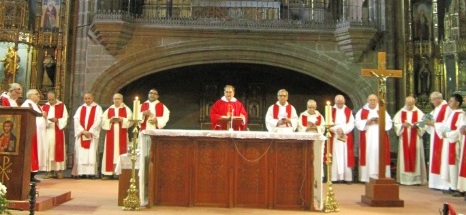
 The chapter brothers are now gathered in Avila since Wednesday, 21 August. The afternoon was ending on a very warm day, a strange thing in Avila. The time for greetings was also a time of surprieses. Some os us met once again after twenty years of absence, and with 20 kilos of extra weight. With more years and less hair. It was a moment thus, of surprises and of fraternity. 35 friars of the Province of the Rosary working in the Far East, in Italy, in Spain and in Venezuela arrived.
The provincial who is ending his term, Fr. Javier Gonzà lez, underscored the importance of these data: five Asian and three Venezuelan friars are attending the Chapter. Everything is symbolic of what is and what shall be the multiculturalityof the Province of the Rosary. For the first time, we needed the services of an official translator, Fr. Mario Jabares. The dean (or the eldest) of the friars is 82 years old, Fr. Agripino Franco, and the youngest is an Asian student brother who is not yet ordained.
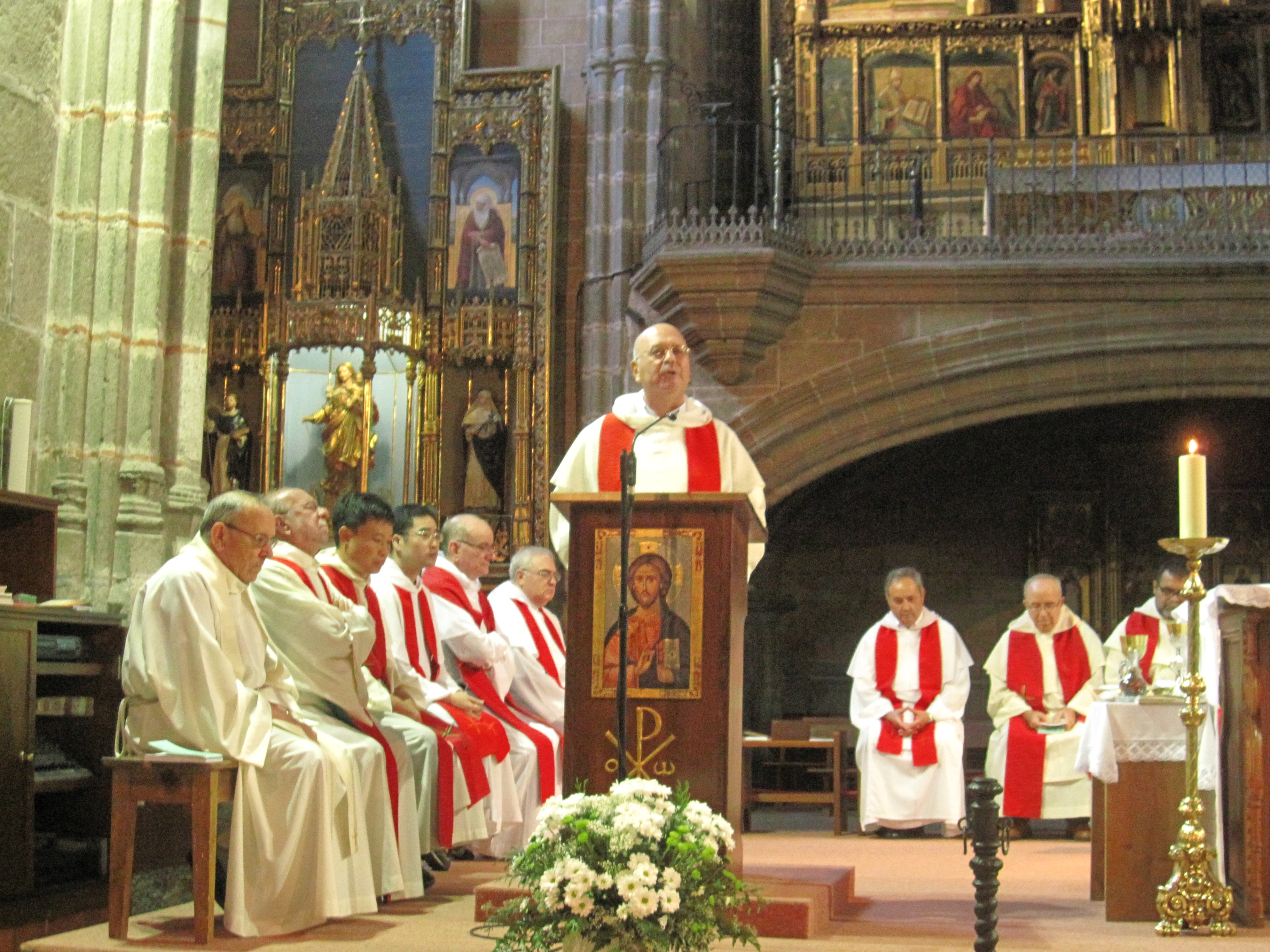
In this first day of the meeting we dedicate it to reflection and prayer. The Vicar of Spain, Fr. Pedro Juan fixed our attention in the situation of the (Convent of) San Pedro Mártir, in Alcobendas (Madrid): The foundations of the principal building slowly giving way, to repair it would be a very costly task. He invited to revise the spiritual “foundations†of the Province and of the friars who form it. The foundation is Jesus Christ and His gospel. In his biblical dissertation he even led us to the well of Sicar, he made us feel the thirst and the weariness which in other times Jesus and the Samaritan woman experienced. The central theme is this: only the Gospel of Jesus can restore, consolidate and regenerate.
The second meditation was directed by Fr . Agripino Franco. His word was well grounded: if one does not care for personal prayer, it weakens community prayer. Both nurture each other. One should not suppose faith, it should be cultivated. Otherwise we lose everything. Pastoral work of a Dominic is centered in Jesús Christ and in his Gospel.
The reflection and conference in the afternoon made by Fr. FelicÃsimo MartÃnez. He situated us before two more frequent questions of religious life today. One, the future of religious life. Today no one dares to make a prophesy the future. The cultural changes of the last fifty years had been so profound and at the same time confusing. No one can imagine the extent of secularization. No one can imagine that the seminaries and religious houses would be left empty in so short a time.
The second question is more compromising: the identity or essential elements of Religious Life. Fr. FelicÃsimo made a magisterial synthesis on the contents of this question. I do not wish to frivolize his deep reflection and I remit to the text that shall be published in full. The day ended in Church: The chapter brothers concelebrated the Eucharist together with the friars of the community of the Royal Monastery. The Prior, Fr. (Rafael) Laya, invited us to trust in the protection of the Virgin Mary, the Queen and Lady of the Church.
Fr. BenjamÃn GarcÃa Fernández (chronicler, and nothing more than this)
 CHRONICLE NUMBER 2
We remember the thought of Ortega y Gasset: “I am and my circumstanceâ€. The context in which we initiate the Provincial Chapter is conflictive: the massacres in Egypt and Syria, nostalgic skirmishes in Gibraltar, some holdups in Spain. These factors did not have any repercussion whatsoever in the dynamics of our Chapter for one simple reason: The contexts of the Far East and Venezuela are different. Meanwhile to speak about the social security, the shortages, the ethnic inequalities, yes they are topics of our context.
WE began the chapter activity on 23 August with a Eucharist that is quite hybrid. We are gathered to the Holy Spirit with Saint Rose of Lima. To the Spirit we asked for light and courage for the task that awaits us. To Saint Rose, to whom we simply watched lovingly: a woman, young, contemplative, continues to be the mirror of all Dominican apostle.
Fr. César Valero in the “Sermo ad Fratres†transported us in almost 18 minutes to the core of the preacher. He reminded us of the four words with with a medieval Cardinal used to convince the Pope so that he would approve the Order founded by Saint Dominic: He said “they are studious brothers of Christâ€. It is a proper definition of a Dominican. Theology, sensibility in the face of the absurd in present day Europe and the poetic wings to raise the spirits of the thirty-five chapter brothers gathered in Avila. Thus it was the Sermo ad Fratres.
To a Dominican, it is expected of him to be clairvoyant for himself and for the task of preaching: we cannot fill life with substitutes of God and of the Gospel of Jesus. Having beside the brethren with such a reflexive capacity and spiritual honorability, the Provincial Chapter is saved.
In the hours of the morning, the superior end his term (of office).. Fr. Javier González, reported on the state of the Province. Something similar done by presidents of countries, yet with a small difference. They either dissimulate or lie. Fr. Javier intensified the rosy color when speaking of Hong Kong and Macao, of China and Corea, of Singapore and Myanmar, of Timor (Leste) and Venezuela. The Province of the Rosary is in the peripheries. Vocations to the religious life emerge in countries that do not have Christian traditions. Europe is a desert..
For the Spaniards, it is easy for us to calculate distances within the national territory; for the Venezuelans, they make it easier by calculating the hours on the road that separates Caracas from Táchira or from Maracaibo. But we are lost when we situate ourselves in the Far East. This geographical absence of mind is similar to cultural and idiomatic. Some countries do not receive foreigners. The relation Church-State in China are thorny. The Province has 267 friars, 10 convents and 26 houses. There are 84 young (brothers) in the period of priestly formation. All of them are Asians. There is an abundance of aspirants but professors and formators are lacking.
Fray Javier exhorted (us) to open the heart and mind to the future in what can se seen in the East. To live in unity, though there might be diverse opinions. To maintain ourselves at the service of the Church. To collaborate with rest of the Province. To maintain a fidelity to the proper vocation. Fr. Javier thanked the friars for the help he had received in these four years of service as provincial. He also asked for apology and forgiveness for the failures he have had. The session ended with a grand applause.
Fr. BenjamÃn GarcÃa Fernández (chronicler and nothing more than that)
(English translation by JS)
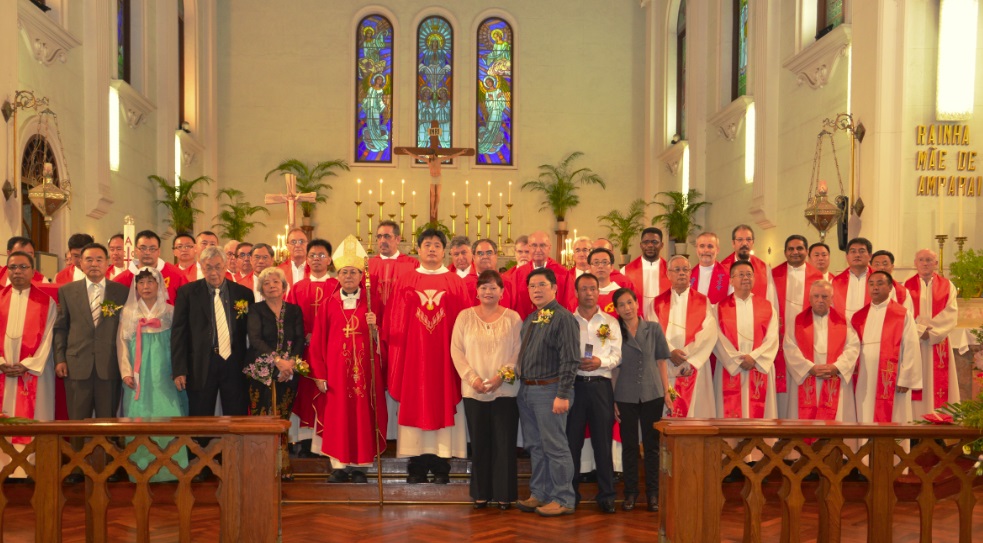
Three Dominican brothers are accepted to the Holy Orders: two for the deaconate, and one for the priesthood.
On June 29, 2013, the Solemnity of the Apostles Peter and Paul three brothers received sacred orders. The place of the ordination: Macau Cathedral. The ordaining prelate: the Bishop of Macau, Joseph Lai, DD. The concelebrants with the Bishop: about forty priests, Dominicans from the communities of Hong Kong and Macau, religious men from the congregations of Macao, and secular priests. Our Dominican brothers were the acolytes. An excellent choir composed of the aspirants of the Dominican Missionaries of the Rosary and the Dominican brothers of our Studium Generale of St. Dominic’s Priory. The faithful that filled the Cathedral were the families and friends of the three ordinandi, religious women of different congregations and some lay faithful from Korea, Singapore, Hong Kong and Macau
The celebration of the Mass and the Rites of Ordination were conducted devotedly and joyfully. The choir animated the celebration with appropriate songs. Among the moving moments of the celebration were the Laying on of Hands by the Bishop and the concelebrating priests, and, as it usually happen in all ordinations, the challenging words of the Bishop to the brothers being ordained that are said first in the Homily and second in the Presentation of the Book of the Gospels: “Believe what your read, teach what you believe and practice what you teach.â€
After the solemn liturgical celebration, Fr. Javier Gonzalez, OP, Prior Provincial of the Province of Our Lady of the Rosary, the Province of the two new deacons and the new priest, gave words of thanks to the Bishop, to the parents of the three newly ordained, to all who prepared and executed superbly the program of the enchanting liturgy, and to all present.
After the Mass, all the people present were invited to a simple reception at the neighboring School of St. Joseph. From there, the special guests were led to a good nearby restaurant to continue the celebration with a light program of songs and speeches that took place while the guests enjoyed tasteful, varied and plentiful Chinese food.
June 29 is a historical day for the Dominicans and for the diocese of Macau! Indeed a red-lettered day to remember.
Thank you, Lord!
 BROTHERS RENEW PROFESSION
Four student brothers just renewed their simple profession on the hands of their Prior Provincial.
On June 29, 2013 Feast of the Apostles Peter and Paul four Dominican student brothers renewed for the first time their simple profession as members of the Order of Preachers. Fr. Javier González, OP, Prior Provincial of Our Lady of the Rosary Province took their promise on behalf of Fr. Bruno Cadoré, OP, Master of the Order. The profession renewal was held at St. Dominic’s Priory during the Morning Prayer of the community.
The four joyful brothers are: Bro. Pius Yu Yo Sin, from Korea; Bro. Antoninus H., from China; Bro. Joseph Tran Van Huong, from Vietnam, and Bro. Luke Tran Van Tam, also from Vietnam
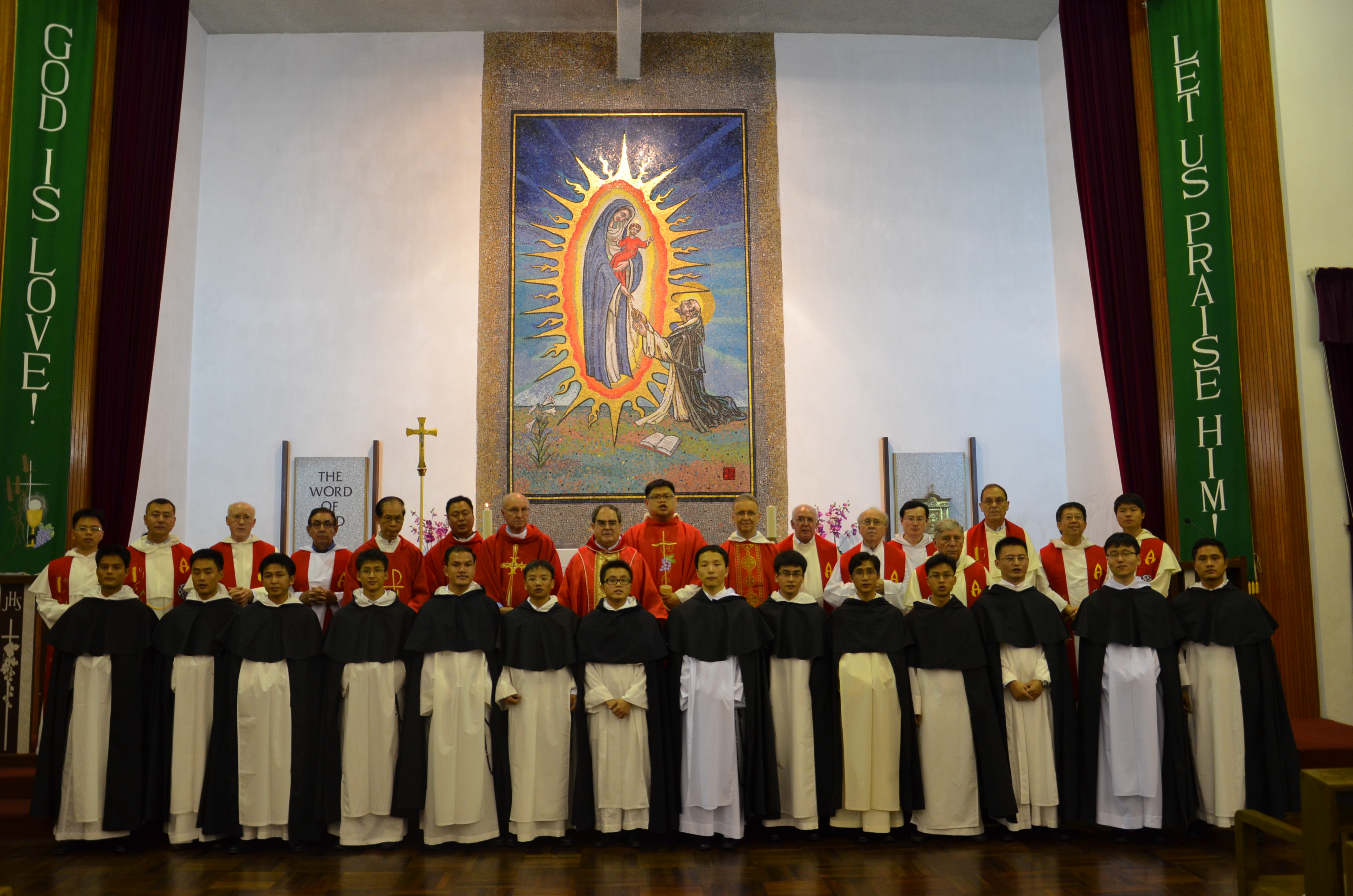
 On June 24th 2013, we have been witnesses of the renewal of the simple profession of Fray Jordan, and the first religious profession of: Fray Bosco, Fray Michael, Fray Anthony, Fray Martin, Fray Christopher, Fray Ignatius and Fray Francis. Likewise, we attended the ceremony of the clothing with the Dominican habit of the new six novices: Raphael, James, Gregory, Albert, Abraham and Peter.
 The ceremony was held at the Chapter of Rosaryhill School and it was presided over by Father Javier González, Prior Provincial. Most of the members of the Province residing in Hong Kong and Macau, were present at the profession and vestition.
 After the religious celebration all those in attendance were invited to share a simple and fraternal dinner at the canteen of the School. (From Secretariat of the Province)