What is Advent?
The word Advent is derived from the Latin word advenire, meaning ‘to come’, referring to the coming of Christ.
In the Catholic Church, Advent refers to the four weeks preceding Christmas, a time of liturgical celebration that highlights the birth of Jesus Christ and, according to biblical prophecy, the Day of Judgment on which he returns.
Advent is a time of spiritual purification, as well as preparing for Jesus’ arrival. Purple is the color used in the vestments during celebrations, a symbol of the beginning of a new liturgical year, which occurs on the first Sunday of Advent.
Advent is a time for penance and spiritual cleansing, but for Christians, it is also a time of joy and rejoicing. This is because it nurtures the hope of the Messiah’s return through the celebration of his birth.
Advent represents Mary’s waiting for the birth of Jesus. This is announced by the Angel Gabriel in a vision in which he told her she was about to conceive the Son of God.
Advent always begins on the Sunday closest to the 30th of November and ends on the 24th of December, Christmas Eve.
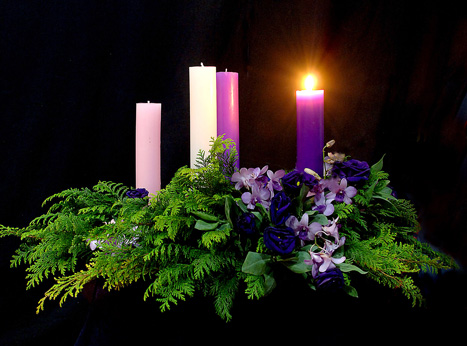
The wreaths of candles has symbolic meanings tied to the Christmas season, and each of them has the meaning that the circle of wreath signifies the eternity of God with no beginning or end. And even each of the individual evergreen that makes up the wreath has the meaning that can be represented to our faith. We don’t mention each of them but the most important is that the wreath as a whole is meant to remind us of both immortality of our soul and God’s promises of everlasting life through our Lord Jesus Christ.
The four candles represent four weeks of Advent, and each candle represents each Sunday. Three candles are purple, the liturgical calendar color that represents the time of prayer, penance, and sacrifice.
The first purple candle symbolizes hope, Sometimes it is called the “Prophecy Candle” in memory of the prophets, especially Isaiah, who prophesied the birth of Christ. It symbolizes the expectation for the coming Messiah.
The second purple candle symbolizes faith. The candle is called the “Bethlehem Candle” as it symbolizes Mary and Joseph’s journey to Bethlehem.
The third candle is pink and symbolizes joy. It is the “Shepherd’s Candle”, and it is pink because rose is the liturgical color for joy. The third Sunday of Advent is Gaudete Sunday and is meant to remind us of the joy that the world experienced at the birth of Jesus, as well as the joy that the faithful have reached the midpoint of Advent.
The four and last purple candle, lighted on the four Sunday of Advent, symbolizes peace. It is the “Angel Candle,” as the angel’s message reminds us “Peace on earth, to the people of goodwill” (Luke 2:14 KJV). It is the final week of prayer, penance as we wait for the arrival of our Saviour.
In modern traditions, the Advent wreath we see does not include a white candle. But the white candle is in place in the middle of the wreath and on Christmas Eve. This candle is named “Christ candle” and it represents the life of Christ. The color white symbolizes purity because Christ is our sinless, pure Saviour.
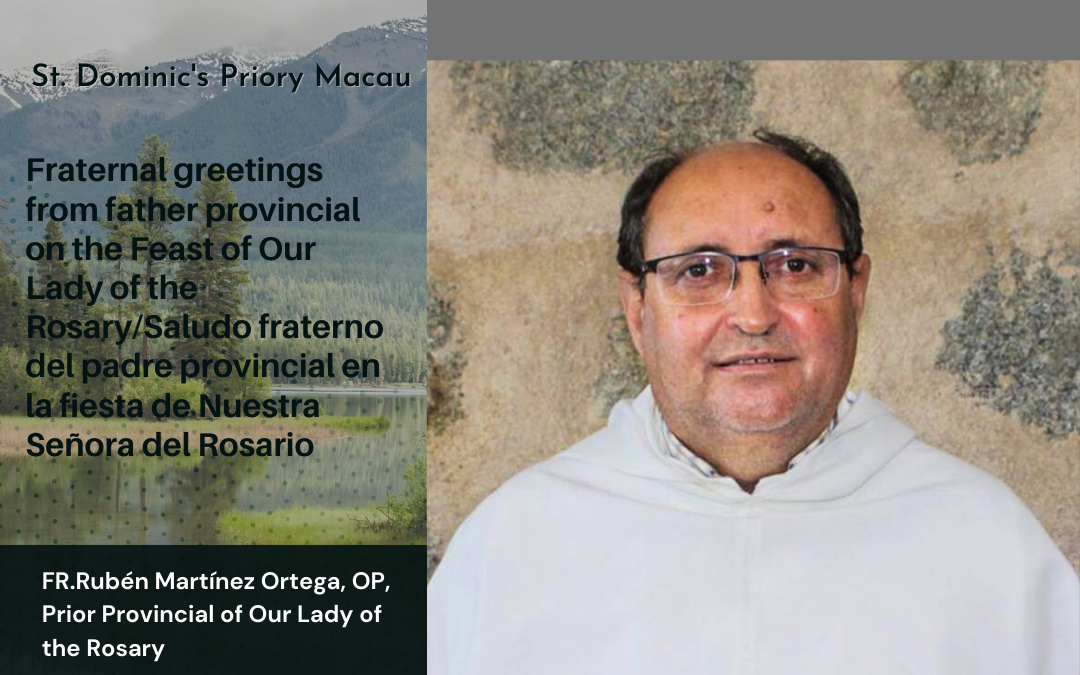
Dear Brothers
From Venezuela, I want to send a fraternal greeting to all the brothers of the Province.
I am having a fraternal visit with our brothers in Venezuela and I am impressed by the work that our brothers here have done for decades. They have left a mark that can never be erased. What they have done will always be there. I am also impressed by the work that our brothers are doing now, by their enthusiasm and desire to do things well.
After two months in office and coinciding with the feast of the Patroness of our Province I would like to share with all the brothers of the Province a short reflection.
We all have a mission and we are all important. We are a community in which all brothers and sisters are living stones. But I get the impression that sometimes we forget this, that we are part of a community. I see that we often get obsessed with thinking about ourselves, doing what each one likes, and forgetting about the community and its future. We can then be an obstacle to the development of the Order. If each one only thinks about his own good, leaving aside the common good, we will be putting a stop to the mission that the Order has entrusted to it in the Church. With intransigence, physical and mental immobility we will scuttle the hard work that has been done so far and we will not allow the Order to move ahead. We will close the door to a better future.
I would like to invite everyone, young and old, to join forces; but above all to reflect on whether each one is an obstacle, a brake on the development of the Order, or if, on the contrary, with his attitude, he is an incentive for the construction of the Order.
Trying to make a project for the future I have seen that there are many young and old brothers who want to stay only in the place where they want, in the place where they think they are happy, or in the place where they think they can help. Brothers who just want everything to remain the same because they are very comfortable where they are. Brothers who forget and put aside their status as Dominican religious and become something else. Is it possible to make a common project with such an attitude? In order to make a common project, to restructure our presences and ministries, all these things are obstacles.
I invite all the brothers to have a high level of vision. Not to be afraid of the future, to make ourselves available to the common project, to know how to be each one in his place and put the best of each one in this common project. It must be everyone’s project for a future that we already have on top, that we must face now. To let more time pass and not make decisions will always be to postpone decisions that will cause more suffering and disinterest. I wonder what are we afraid of? St. Dominic lived himself into an uncertain future with courage and faith. He always exhorted the brothers to live a fraternal life in the community as a sign of communion and as the first place of preaching. He always invited the brothers to found convents as the basis for that fraternity.
On this day of Our Lady of the Rosary, our intercessor and our patroness, the mother who always encourages us not to be afraid of the challenges we have, today she invites us, as a good mother, to make a common project, without individualism, respecting each one’s values, knowing how to listen to each other and knowing how to be each one in his place. She Invites us to rethink what we do, how we do it, and where we do it. All to make a common project for the future and not stagnant in time.
I ask that this letter be read on the feast day of Our Lady of the Rosary in all the communities of the Province in the celebration of the Vespers, that the superiors exhort the brothers to think more about the common good than about their own and propose a day in the month of October to make a reflection in the community on the common project.
Happy Feastday. May the Lord pour out his grace on us, and may the Virgin of the Rosary protect us and encourage us to live our Dominican life to the fullest.
Fraternally
Fr. Ruben OP.
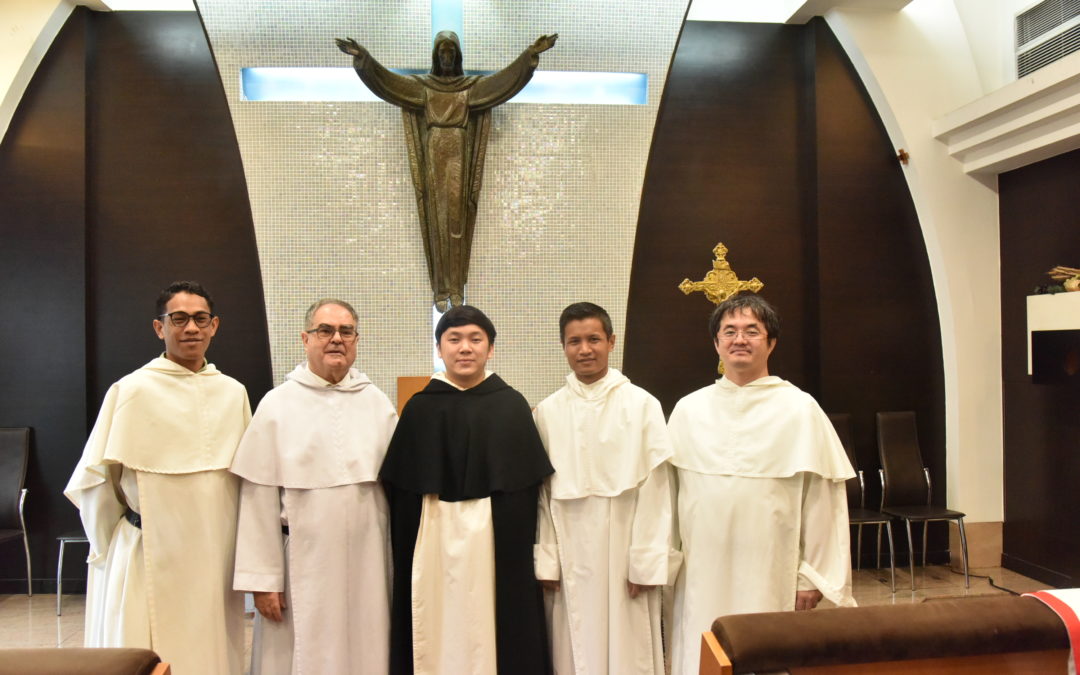
On 8 September 2021, the feast day of the Nativity of the Blessed Virgin Mary, our Burmese Brother Fermin Saw Simon Htoo renewed his profession in Macau. The renewal ceremony took place during the conventual Mass at St Dominic’s Priory, in the presence of the community and of some members of the Dominican Family. I promise obedience to God, to Blessed Mary, and to Blessed Dominic’s were Brother Fermin’s words, following the formula of profession used in the Dominican Order. Obedience not only to God but also to Blessed Mary. This shows the place of honor that Mary has always been given in the Order, which was placed under her tutelage from its foundation. Very fittingly, on this feast day of her Nativity, our Brother Fermin manifested his intention of dedicating his life to Jesus Christ, to whom also Mary dedicated her life. Our warmest congratulations.