CHRONICLE NUMBER 1
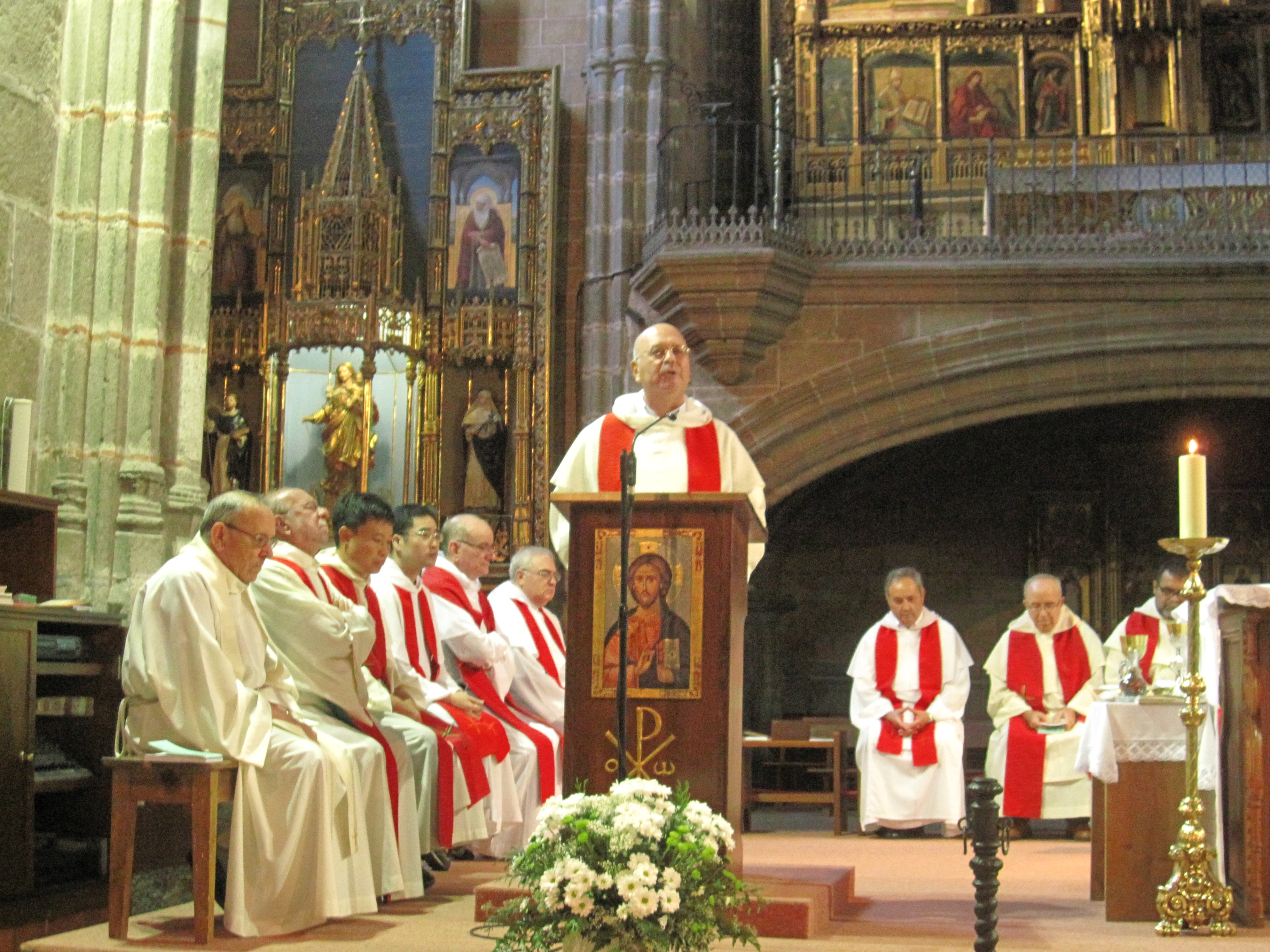
 The chapter brothers are now gathered in Avila since Wednesday, 21 August. The afternoon was ending on a very warm day, a strange thing in Avila. The time for greetings was also a time of surprieses. Some os us met once again after twenty years of absence, and with 20 kilos of extra weight. With more years and less hair. It was a moment thus, of surprises and of fraternity. 35 friars of the Province of the Rosary working in the Far East, in Italy, in Spain and in Venezuela arrived.
The provincial who is ending his term, Fr. Javier Gonzà lez, underscored the importance of these data: five Asian and three Venezuelan friars are attending the Chapter. Everything is symbolic of what is and what shall be the multiculturalityof the Province of the Rosary. For the first time, we needed the services of an official translator, Fr. Mario Jabares. The dean (or the eldest) of the friars is 82 years old, Fr. Agripino Franco, and the youngest is an Asian student brother who is not yet ordained.
In this first day of the meeting we dedicate it to reflection and prayer. The Vicar of Spain, Fr. Pedro Juan fixed our attention in the situation of the (Convent of) San Pedro Mártir, in Alcobendas (Madrid): The foundations of the principal building slowly giving way, to repair it would be a very costly task. He invited to revise the spiritual “foundations†of the Province and of the friars who form it. The foundation is Jesus Christ and His gospel. In his biblical dissertation he even led us to the well of Sicar, he made us feel the thirst and the weariness which in other times Jesus and the Samaritan woman experienced. The central theme is this: only the Gospel of Jesus can restore, consolidate and regenerate.
The second meditation was directed by Fr . Agripino Franco. His word was well grounded: if one does not care for personal prayer, it weakens community prayer. Both nurture each other. One should not suppose faith, it should be cultivated. Otherwise we lose everything. Pastoral work of a Dominic is centered in Jesús Christ and in his Gospel.
The reflection and conference in the afternoon made by Fr. FelicÃsimo MartÃnez. He situated us before two more frequent questions of religious life today. One, the future of religious life. Today no one dares to make a prophesy the future. The cultural changes of the last fifty years had been so profound and at the same time confusing. No one can imagine the extent of secularization. No one can imagine that the seminaries and religious houses would be left empty in so short a time.
The second question is more compromising: the identity or essential elements of Religious Life. Fr. FelicÃsimo made a magisterial synthesis on the contents of this question. I do not wish to frivolize his deep reflection and I remit to the text that shall be published in full. The day ended in Church: The chapter brothers concelebrated the Eucharist together with the friars of the community of the Royal Monastery. The Prior, Fr. (Rafael) Laya, invited us to trust in the protection of the Virgin Mary, the Queen and Lady of the Church.
Fr. BenjamÃn GarcÃa Fernández (chronicler, and nothing more than this)
 CHRONICLE NUMBER 2
We remember the thought of Ortega y Gasset: “I am and my circumstanceâ€. The context in which we initiate the Provincial Chapter is conflictive: the massacres in Egypt and Syria, nostalgic skirmishes in Gibraltar, some holdups in Spain. These factors did not have any repercussion whatsoever in the dynamics of our Chapter for one simple reason: The contexts of the Far East and Venezuela are different. Meanwhile to speak about the social security, the shortages, the ethnic inequalities, yes they are topics of our context.
WE began the chapter activity on 23 August with a Eucharist that is quite hybrid. We are gathered to the Holy Spirit with Saint Rose of Lima. To the Spirit we asked for light and courage for the task that awaits us. To Saint Rose, to whom we simply watched lovingly: a woman, young, contemplative, continues to be the mirror of all Dominican apostle.
Fr. César Valero in the “Sermo ad Fratres†transported us in almost 18 minutes to the core of the preacher. He reminded us of the four words with with a medieval Cardinal used to convince the Pope so that he would approve the Order founded by Saint Dominic: He said “they are studious brothers of Christâ€. It is a proper definition of a Dominican. Theology, sensibility in the face of the absurd in present day Europe and the poetic wings to raise the spirits of the thirty-five chapter brothers gathered in Avila. Thus it was the Sermo ad Fratres.
To a Dominican, it is expected of him to be clairvoyant for himself and for the task of preaching: we cannot fill life with substitutes of God and of the Gospel of Jesus. Having beside the brethren with such a reflexive capacity and spiritual honorability, the Provincial Chapter is saved.
In the hours of the morning, the superior end his term (of office).. Fr. Javier González, reported on the state of the Province. Something similar done by presidents of countries, yet with a small difference. They either dissimulate or lie. Fr. Javier intensified the rosy color when speaking of Hong Kong and Macao, of China and Corea, of Singapore and Myanmar, of Timor (Leste) and Venezuela. The Province of the Rosary is in the peripheries. Vocations to the religious life emerge in countries that do not have Christian traditions. Europe is a desert..
For the Spaniards, it is easy for us to calculate distances within the national territory; for the Venezuelans, they make it easier by calculating the hours on the road that separates Caracas from Táchira or from Maracaibo. But we are lost when we situate ourselves in the Far East. This geographical absence of mind is similar to cultural and idiomatic. Some countries do not receive foreigners. The relation Church-State in China are thorny. The Province has 267 friars, 10 convents and 26 houses. There are 84 young (brothers) in the period of priestly formation. All of them are Asians. There is an abundance of aspirants but professors and formators are lacking.
Fray Javier exhorted (us) to open the heart and mind to the future in what can se seen in the East. To live in unity, though there might be diverse opinions. To maintain ourselves at the service of the Church. To collaborate with rest of the Province. To maintain a fidelity to the proper vocation. Fr. Javier thanked the friars for the help he had received in these four years of service as provincial. He also asked for apology and forgiveness for the failures he have had. The session ended with a grand applause.
Fr. BenjamÃn GarcÃa Fernández (chronicler and nothing more than that)
(English translation by JS)
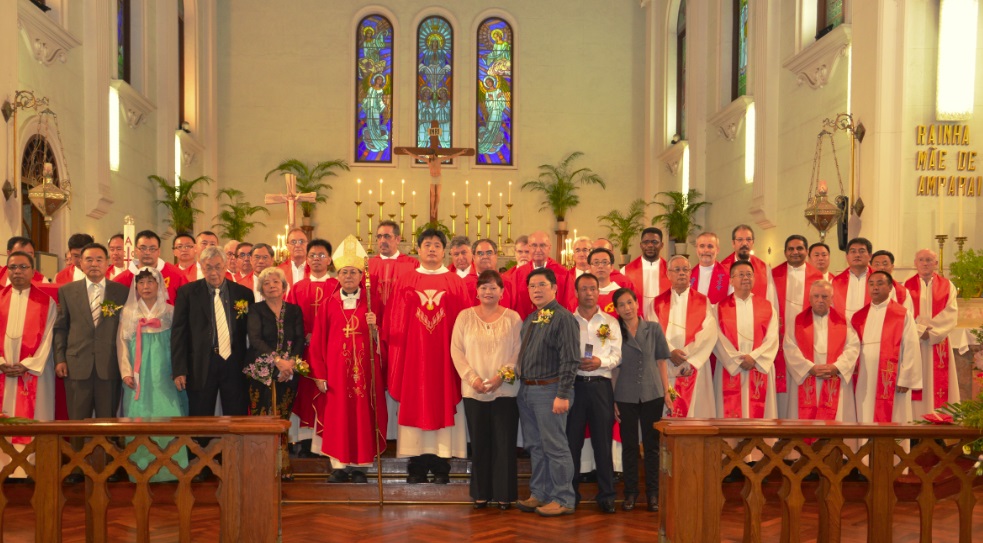
Three Dominican brothers are accepted to the Holy Orders: two for the deaconate, and one for the priesthood.
On June 29, 2013, the Solemnity of the Apostles Peter and Paul three brothers received sacred orders. The place of the ordination: Macau Cathedral. The ordaining prelate: the Bishop of Macau, Joseph Lai, DD. The concelebrants with the Bishop: about forty priests, Dominicans from the communities of Hong Kong and Macau, religious men from the congregations of Macao, and secular priests. Our Dominican brothers were the acolytes. An excellent choir composed of the aspirants of the Dominican Missionaries of the Rosary and the Dominican brothers of our Studium Generale of St. Dominic’s Priory. The faithful that filled the Cathedral were the families and friends of the three ordinandi, religious women of different congregations and some lay faithful from Korea, Singapore, Hong Kong and Macau
The celebration of the Mass and the Rites of Ordination were conducted devotedly and joyfully. The choir animated the celebration with appropriate songs. Among the moving moments of the celebration were the Laying on of Hands by the Bishop and the concelebrating priests, and, as it usually happen in all ordinations, the challenging words of the Bishop to the brothers being ordained that are said first in the Homily and second in the Presentation of the Book of the Gospels: “Believe what your read, teach what you believe and practice what you teach.â€
After the solemn liturgical celebration, Fr. Javier Gonzalez, OP, Prior Provincial of the Province of Our Lady of the Rosary, the Province of the two new deacons and the new priest, gave words of thanks to the Bishop, to the parents of the three newly ordained, to all who prepared and executed superbly the program of the enchanting liturgy, and to all present.
After the Mass, all the people present were invited to a simple reception at the neighboring School of St. Joseph. From there, the special guests were led to a good nearby restaurant to continue the celebration with a light program of songs and speeches that took place while the guests enjoyed tasteful, varied and plentiful Chinese food.
June 29 is a historical day for the Dominicans and for the diocese of Macau! Indeed a red-lettered day to remember.
Thank you, Lord!
 BROTHERS RENEW PROFESSION
Four student brothers just renewed their simple profession on the hands of their Prior Provincial.
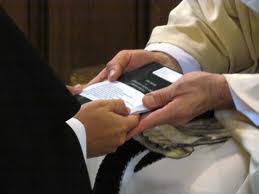
On June 29, 2013 Feast of the Apostles Peter and Paul four Dominican student brothers renewed for the first time their simple profession as members of the Order of Preachers. Fr. Javier González, OP, Prior Provincial of Our Lady of the Rosary Province took their promise on behalf of Fr. Bruno Cadoré, OP, Master of the Order. The profession renewal was held at St. Dominic’s Priory during the Morning Prayer of the community.
The four joyful brothers are: Bro. Pius Yu Yo Sin, from Korea; Bro. Antoninus H., from China; Bro. Joseph Tran Van Huong, from Vietnam, and Bro. Luke Tran Van Tam, also from Vietnam
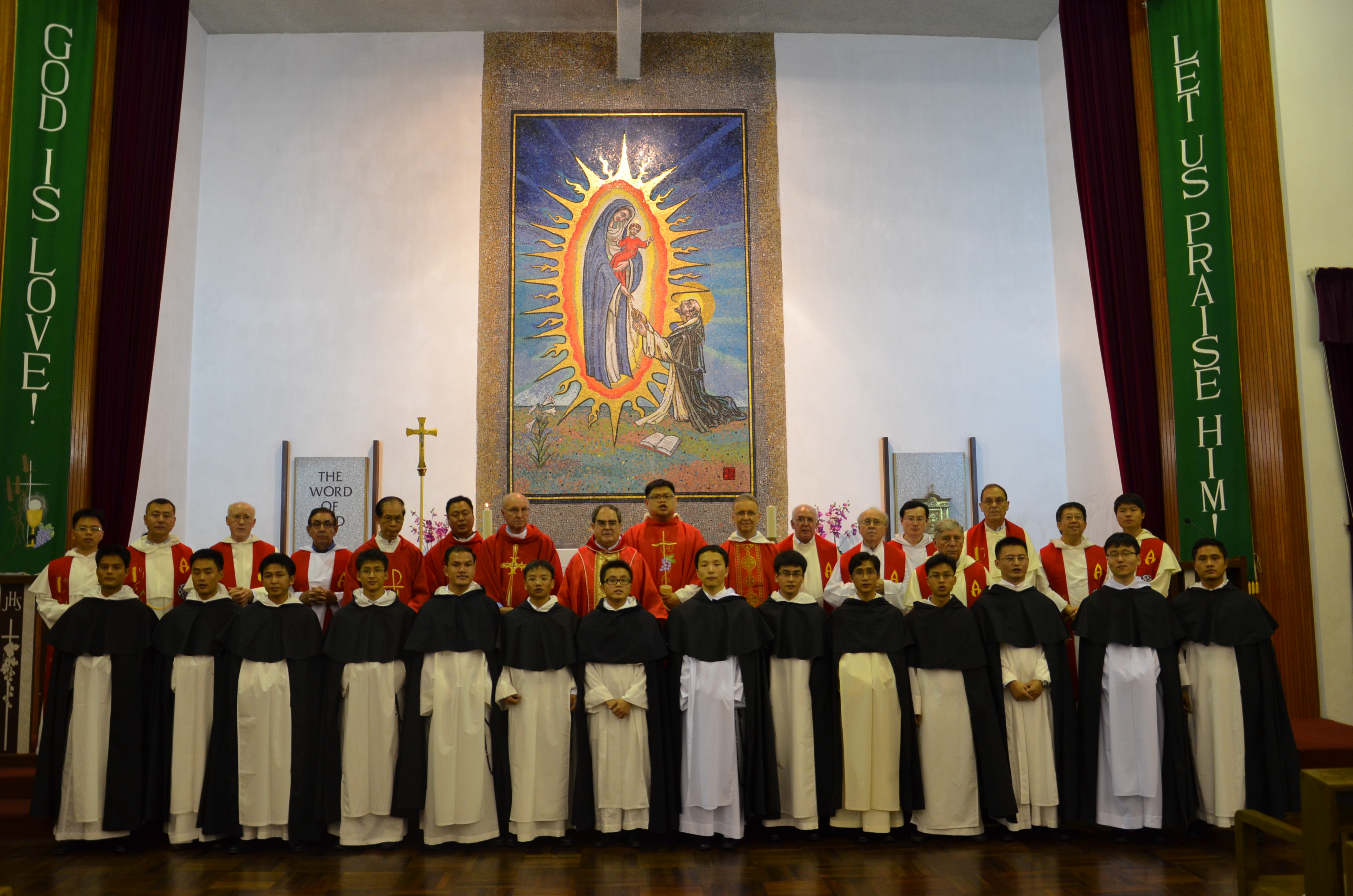
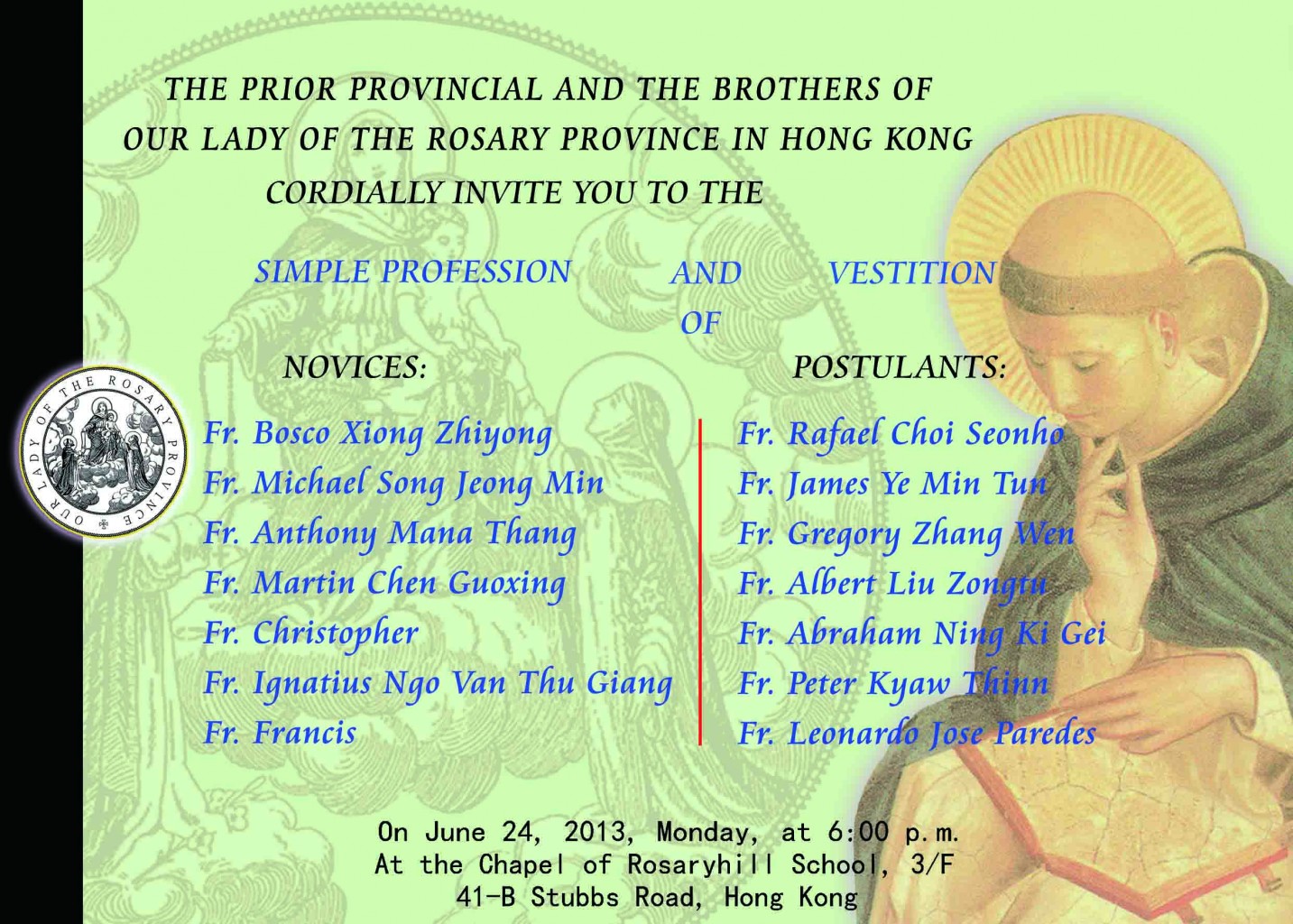
 On June 24th 2013, we have been witnesses of the renewal of the simple profession of Fray Jordan, and the first religious profession of: Fray Bosco, Fray Michael, Fray Anthony, Fray Martin, Fray Christopher, Fray Ignatius and Fray Francis. Likewise, we attended the ceremony of the clothing with the Dominican habit of the new six novices: Raphael, James, Gregory, Albert, Abraham and Peter.
 The ceremony was held at the Chapter of Rosaryhill School and it was presided over by Father Javier González, Prior Provincial. Most of the members of the Province residing in Hong Kong and Macau, were present at the profession and vestition.
 After the religious celebration all those in attendance were invited to share a simple and fraternal dinner at the canteen of the School. (From Secretariat of the Province)

We publish here the interview conducted by one of our student brothers to a priest from Myanmar who visited our community recently. Bro. Paul Win Aung Mying interviewed Fr. Alphonse Ko Lay. It is a very informative and interesting interview for us Dominicans of the Province of Our Lady of the Rosary. At present we have a Dominican community in Yangon, Myanmar, and soon we shall open a second one. Moreover, the Province has a good number of vocations from Myanmar and some of them, with other brothers from other countries, are ready to start ministering there. (Editor)
Question: Hello Father, It’s very nice to meet you. Could you introduce yourself?
Answer: Â I am Fr. Alphonse Ko Lay from Burma. I have been a priest for 39 years already. I was ordained in 1974. Let me add, that I am very happy to be here in Macau. I thank the Dominicans for their hospitability and warm welcome.
And now here are the highlights of my life. I was born in upper Burma at the village of Chanthaywa where the Barnabites started their mission in 1720. I was brought up by the Salesians in Mandalay. I spent 4 years as an aspirant and was sent to India for my novitiate year and philosophy. I came back to Burma in 1965 and after 3 months of my teaching at Laphon Salesian School, the schools were nationalized by the socialist government. From then on, our religious congregation had nowhere to go. So many of us left the congregation and, in fact, I myself went home first. After two year of staying at home, the bishop called me back to become a diocesan priest; I joined the Mandalay diocese and was ordained a priest in 1974. Immediately after my ordination, I was appointed to work in the mission of the Chin State, a remote area; I worked there for 8 years. Later on, I was appointed to my native place called Monhla for 10 years. Afterwards, I was appointed the secretary of the late Archbishop and parish priest of Sagain which is right after Mandalay. Then, I was transferred to Chantha Gone near where the Dominicans are now established themselves. Lately I was called to Yangon by the Archbishop of Yangon to coordinate three commissions, namely, the Commission of the Liturgy, the Commission of the Clergy and the Commission of Public Relations. Now, since I have reached old age, I will move back to a parish of Mandalay diocese called ‘the Sacred Heart Church’ in Pyin Oo Lwin.
 When you were working for the three commissions in Yangon was it just for a particular diocese or for the whole Church of Myanmar – at the national level of the Catholic Bishops’ Conference of Myanmar (CBCM)?
I was working at the national level. In fact, I have been working for the Commission of Liturgy for 30 years already. This is an episcopal commission and I was its secretary. I prepared the Order for the Celebration of Eucharist and the Liturgy of the Hours; I translated many liturgical texts into Burmese for this Order and Liturgy. Â In the year 2000, I initiated the Episcopal Commission of the Clergy after I came back from the Philippines: I realized the need for our priests in Myanmar to work together, to help each other in our spiritual needs and in other difficulties. I was an active secretary for that commission for ten years. And then, the Commission for Public Relations started when the country opened up to the world. Our Bishops found this need, and they thought I could help in this endeavor and appointed me for this task.
 How is the Public Relations Commission going on now?
It’s a little hard for me to work for the Public Relations Commission because the country has just opened up. But this commission is also important: we need to have open communication with diplomats; we need to have dialogue with others groups such as with the inter-faith families and other social groups. But the government has a lot of suspicion when we do something. As a whole, I have to add that I didn’t find much success in this task until now.
 Taking advantage of this opportunity to interview you, Father, I would like to hear something about situation of the Church in Myanmar. May I ask you to start telling us briefly about the history of the Church in Myanmar?
To talk briefly about the history of the Church in Myanmar, I would like to point out its main highlights. Christianity was introduced in our land at the beginning to 17th century; it was then with not much organization. Then from the beginning of the 18th century, the Church became well organized under the leadership of the Barnabite missionaries who arrived in Myanmar in 1720; they ended up in 1820; this was a beautiful time for the Church in Myanmar as these missionaries organized very well with bishop the emerging Church; I really love them for their splendid missionary work and evangelization. After them came the Oblate fathers, but worked in Myanmar for only 20 years. After that, from 1840s, we had the PIME fathers who continued the evangelization and missionary tasks in Myanmar. Then we started to have the so called foreign educational institutes like religious communities, especially the women religious communities who came and opened schools, the Christian brothers and many local diocesan clergy and bishops. Myanmar was divided then into many parts with French missionaries in Yangon and the Mandalay area, American missionaries in Prome and Rakhine, Italian missionaries in Tongnoo and all the Shan State, and Irish missionaries in the North. By 1954, we had a native bishop appointed by Rome and thus the native Church was born. In the 1960s, all the foreign missionaries were kicked out by the Socialist government, especially in the 1970s. As a result, we didn’t have any foreigners in Myanmar anymore; no foreigner missionaries either in religious communities or in the dioceses. From then on, the local bishops and religious superiors took charge of the Church in Myanmar.
 Some years ago, Myanmar began to re-open to the world. May I ask, how is the current situation and conditions after the so called “country reform�
After the democratic march in 1988, the Socialist government of U Nay Win stepped down and the military junta began to hold all the power. From then on, the Church has not been able to do much. With the Church, even the whole country has been looking since then for a better government. From 2008 with the fundamental constitution, the country has changed a lot. Many people are happy with this change. However, the Church, the secular world and especially even the government itself were not ready for this change. They don’t know well how to carry out the reform. They just know there is a need to change. Practically, we are not fully satisfied yet with the changes taking place.
 How is the relationship between the Church and the government now after the positive change that continues taking place in Myanmar?
After the change, I met personally with the minister for religious affairs who told me with beautiful words that the new government is not for the government itself but for our people and for you, religious people. And he added that they are opened, so you may come and contact us anytime. At least now we have a relationship between the Church and the government. Previously, we couldn’t have any voice but now we are welcomed by the government and listened to. I don’t know how long they will welcome us but I think that this new attitude represents a big step forward in our relationship.
 What do you think of the role and contribution of the Myanmar Church to the development of the country?
Practically, I have to say that the Church has been involved in many social activities. In particular, whenever there is a natural or man-made disaster, the Church through its social action arm Caritas has been actively involved by giving different kinds of assistance to the poor and needy people. For example, last 2008 the country faced a big disaster called Nargis Cyclone which took many lives and damaged many, many properties. Of course, the Church is not only committed to help when there are these kinds of disasters, but also and consistently to provide education to the poor children, to help in the development in the rural areas and so on. Generally, the activity of Myanmar Caritas is very strong and wide. Since the government has reopened, we have to work further in missions along these lines. Moreover, we are known as good educators in Myanmar. Unfortunately our new generations seem not to be ready to take this task as their own education itself was very insufficient under the junta. Even the priests and young religious have not received a good education. Therefore, I think that perhaps we are not ready for this mission in the meantime. We lack this kind of qualification to give a better education. And another encounter is that all our missionaries’ schools were nationalized and none of them has been given back to us. I am not very clear about the policy regarding these nationalized schools, and whether the owners of these schools will claim them back or not. Of course, we now have many big missionaries’ schools in the country especially in Yangon and Mandalay. Even if we get the properties back, we don’t know very well how to re-start this mission. And the question is: who will run the schools?
 Do you think that the government would ask the Church to take this educational task?
The present government is very sensitive regarding many things. It seems to be good and we are happy about it; but we are not that sure if we can already trust the government fully. It appears that sometimes those in power have other ways to say something else. Personally I don’t think the government will directly or openly ask the Church for this role. Yet, apart from the nationalized schools, there are many private schools in Myanmar run as a business in the field of education. So there are many educational enterprises, but the Church is not yet there. Still we are hopeful.
 After the country began changing and opened to the outside, many people around the world are interested in Myanmar, including religious congregations also interested to come to Myanmar. May I ask: what contributions and missions could they bring into the country when they come?
This is a good question to be asked, brother. As the country has rapidly changed and opened to the world, many people especially the businessmen from all over the world are busy with coming in and out of our country. Politically, many countries are observing and watching since Myanmar is located between the big two countries China and India. They want to balance the political power in the world. However, from the point of the Church, I am so sad that none of the religious congregations have started their mission; none of them has come yet – not even to observe our situation and conditions. Of course, we have some Dominicans and Jesuits that had already started before. Today when the world’s economic and political movements are so fast, the Church should also move fast. The question now is not whether they could settle or not; but I wish they would just come and talk with our bishops, our episcopal conference the CBCM. Now this is a good time to work for the Church and the country.
 You know well that recently there were many big clashes between Buddhists and Muslims in Myanmar. Somehow this has become a huge block for many foreign investors, businessmen and other people to come to Myanmar. So what do you think about this? What is your comment on it?
It’s more than the religious clashes between Buddhists and Muslims. There are many hidden things behind the clashes. Many people believe that political games are being played or aroused by the junta and some political activists. What are the reasons for a lot of crashes? Some groups want that the country changes slowly and gradually; but some other groups see that the country needs a rapid change to be able to level up with other countries around the world. There seems to be mistrust in the government.
What do you expect from our Dominican mission in Myanmar?
I am very grateful to the Dominicans here in Macau with their prior and all the members for their hospitality and everything. I really expect two nutritious foods for your mission in Myanmar. In the first place, it is the spirituality. We need a very good and profound spirituality in Myanmar as the local priests and people are longing for it; we really need the Dominican Spirituality. Secondly, it’s the intellectual food. As you know, Myanmar has a lot to do with education and above all, the local priests, sisters and the faithful need it. Therefore, the spiritual and intellectual foods are what we hunger and thirst the most. I hope and pray that the Dominicans will bring them and feed our people. God bless the Dominicans!
 Dear Fr. Alphonse, could you give us some final words?
Finally I would like to invite all of you to the great feast that we are going to celebrate in Myanmar for the 500th anniversary of the arrival of Catholicism in Myanmar. That’s why I came here to do something for the preparation of the great feast.
           Thank you very much, Father. God bless you and your work for his Kingdom.
Bro. Paul Win Aung Myint, OP
St. Dominic Center of Studies, Macau

On June 17, 2013 Fr. Lancelote, a very popular priest of Macau was taken by the Good Lord to heaven. He was ninety years old. On June 22, His Funeral Mass was celebrated at the Macau Cathedral with participation of priests, relatives, friends and hundreds of ordinary lay faithful that filled the Church. The Bishop of Macau, the Most Reverend Joseph Lai presided over the Eucharist and over thirty secular and religious priests concelebrated with him, including some Dominicans. After the Mass, the burial took place at the St. Michael Archangel Catholic Cemetery.
Of Portuguese descent, Fr. Lancelote was born in Malacca, Malaysia on December 21, 1949. He was ordained priest in Macau on October 6, 1949. As the Macau delegate of Catholic Social Services-USCC and Director of the Secretariat of od the Diocesan Services for Social Welfare Macau, the good priest dedicated himself for nearly six decades to social services not only in Macau but also in Mainland China and other neighboring countries.
Fr. Lancelote is a household name in Macau, where he served the Diocese and the people with competence, dedication and great generosity. He was well-known for his total commitment to refugees, the poor, the disabled and other disadvantaged minorities.
Fr Lancelote was a close friend of the Dominican in Macau. I fact, he was for a long time the only Dominican Tertiary in Macau.
Well done, brother. May you rest in peace!Â