The World Health Organization (WHO) gives a clinical definition of infertility as a disease of the reproductive system deined by the failure to achieve a clinical pregnancy after 12 months or more of regular unprotected sexual intercourse.[1] This definition dates from 2009; however, in 2016, some information about the change in this definition came about.
WHO web page states clearly: WHO has not changed its use of this definition. It is important to note that this definition provides a clinical description of infertility. It does not make any recommendations about the provision of fertility care services. WHO is not planning to make any changes to the definition of infertility. WHO is currently developing guidelines on the diagnosis and management of infertility.
Interestingly, the current information points out some changes (proposal of) in the definition that, considering the number of web pages holding the same information, may appear sooner or later. For instance, Herjeet Marway and Gulzaar Barn, both lecturers at the University of Birmingham, state that the World Health Organization proposal is to change the definition of infertility. This would move it away from a clinical disease-based definition where it is viewed as a disability to a view that includes a more social definition, recognizing it as a right to reproduce. Moreover, they state that infertility would not be the failure to achieve a clinical pregnancy after 12 months or more of regular unprotected sexual intercourse. Rather, it would also be considered to include cases when single men and women without medical issues do not have children but want to become a parent.[3]
A recent article sustains that David Adamson, MD, one of the authors of the new guidelines, told The Telegraph the change is designed to reflect “the rights of all individuals to have a family, and that includes single men, single women, gay men, gay women.[4] David Adamson works as a Reproductive Medicine Expert to WHO. In the same article, this new definition of infertility has the potential to become a great equalizer of reproductive rights: It fundamentally alters who should be [classified as infertile] and who should have access to healthcare, said Dr. Adamson it sets an international legal standard.[5]
All this has a direct relation with the topic of study since surrogacy can be the means more suitable for these single men, single women, gay men, and gay women who, without medical issues, do not have children but want to become parents.
The society is a dynamic system, changing in all spheres of knowledge; the Church is part of this dynamic system; therefore it is interesting to give an account of the position of the Church regarding paternity, surrogacy and this probable change in the definition of infertility provided by the World Health Organization.
This research/reflection paper deals with de definition of infertility and its relation to surrogacy. Before going forward, it is interesting to trace, more or less, the usage of the word sterility. For this purpose, the author will quote some insights found in Infertility: Tracing the History of a Transformative Term written by Robin E. Jensen (2016). Choosing this work is because of its historical view and the use of the term mechanical regarding the human body. According to the text, there is a similarity between the human body and a piece of machinery, in moments of malfunction, it needs repairing. Even though this comparison seems to be metaphorically correct (and nave), the acceptance of comparing the human body with an engine, for instance, will lead to approach the woman womb, and therefore surrogacy, in a materialistic way, manipulable at the person will.
Early twentieth-century medical experts routinely described married women without children as fruitless and in need of repair barren and broken, thereby framing women inability to bear children through the conflicting lenses of the natural organic world and the world of machines.[6] With this affirmation, it is understandable that the condition of fertility/infertility has become an excellent mechanical process or one in need of repairing.
According to Jensen, in the context of contemporary women reproductive health, the term (in) fertility is as ubiquitous as it is fraught with seemingly endless uses and connotations. But it was not until 1868 that the obstetrician James Matthews Duncan first used the word fertile to reference women who gave birth (or had the potential to give birth) to numerous children.[7] As time goes on, Duncan metaphor had moved into the realm of the literal, as physicians routinely enlisted the term fertile to describe women with many spring (or the potential for many spring), just as they enlisted the term infertile to describe married women who remained childless (or who bore few children).[8]
Here in these definitions, both of fertile and infertile women, there is a common framework: married women; the author considers that, even in the field of medical research, the value of marriage is present while regarding the conception and birth of a child, putting out of the definition single persons.
The history of civilizations has documented the word infertility several times. Being Christianity an essential part of human history, it is not strange to find references to this condition in the Bible the story of Sarah, Abraham wife, for instance which will give a direct link with the divine. Extensive discourse about women reproductive problems and capabilities can be traced back as far as the writings of ancient Egyptians, Hebrews, and pre- Hippocratic Greeks. Over the past few centuries, the terms barren and then sterile have functioned as metaphorical predecessors to infertile serving as common denotations for women inability to become pregnant or bear healthy children.[9]
Jensen writes regarding fertility: Nineteenth-century rhetoric referred to sterile female bodies as machines in need of repair by a surgeon and, in this way, constituted women as somewhat outside the realm of culpability for their childlessness. This rhetoric, in contrast to earlier rhetoric that referred to women as barren and therefore unbalanced, unnatural, cored them few opportunities for self- help but much in the way of surgical hope (despite the relatively bleak success rates of surgical interventions at the time). Sterile bodies could be fixed by medical intervention.[10]
In this sense, the question about the right of having a child shows up in the ethical scenario. If the logic relation 1:1 is made upon the basis of the human body: machine, the idea of surrogacy is valid and fosterable, accepting the surrogated womb/mother just as a factory of babies; consequently, any person will be able to claim his/her right to have a child. This worldly way of thinking cannot be the answer to the question about surrogacy and its implications in society.
Moreover, if the case is to take the aforesaid idea literally, homosexual couples have to be discarded out of the possibility of making use of surrogacy, because it is the female body that needs to be repaired so as to function correctly. The union of male and female continues to be the conceptive way. It takes away the idea of the rights of all individuals to have a family, and that includes single men, single women, gay men, gay women, which is the implication of a future change in the definition of infertility given by WHO.
Jensen work ends with an interesting statement: The mixing of perceptual lenses from centuries past lenses with divergent assumptions about blame and responsibility, morality and science foretold an era in which articulating infertility involved a complicated, fraught balance of divergent appeals, as well as one in which the meaning of infertility was constantly reinvented according to the circulation and percolation of scientia coincindings, medical technologies, media depictions, and lay discourses.[11]
One of the scientific findings is that of infertility in men. The history of the word infertility has a female connotation, both in the scientific and religious fields. Jensen work is clear evidence of this, and for all those who are familiar with the Bible, they know that there is no even one account of male sterility/infertility. At knowing this, the author considers that there is a double disrespect towards women, namely, to have found only women unable to have a child because of countless reasons; and to consider now the surrogacy as an alternative for becoming parents.
As a final point, the author reflects on the so-called right to have a child which is a controversial issue if the definition of infertility changes. For this purpose, it is necessary to consider the United Nations Universal Declaration of Human Rights and the insights of Robert Spaedmann on Human dignity.
Now, the second main feature of the human being is his/her dignity. According to the United Nations (UN) all human beings are born free and equal in dignity and rights. They are endowed with reason and conscience and should act towards one another in a spirit of brotherhood.[12] This statement is taken from The Universal Declaration of Human Rights emphasizes two main concepts for this research, namely: dignity and rights. Reading the UN Declaration on Human Rights there is no mention at all of the right of having a child.
According to Spaedmann, quoted by Zaborowski, person is not the name of a species, but a general proper name for each member of a species this name says who we are, and this is evidently not simply identical with what we are.[13] If this definition can be applied to the topic in this research, it is clear that Marie, Anna, Laura, Peter, John, any person who may be infertile continue to be a human being, this is who she/he is therefore her/his dignity is not conferred by the fact of being parents.
Furthermore, Spaedmann writes that persons are in an unparalleled sense individuals, because of their freedom and their capacity to transcend themselves no longer mere parts, but a whole, which cannot be accounted for as a means to an end.[14] This statement is very important here because taking into account Duncan/Jensen metaphor of the body as a piece of machinery in need to be repaired, the human person/body is treated as parts instead of as a whole; moreover, this part in need of reparation is regarded as a means to have a child, to have a child is not the real transcendence of a person.
To complete this idea, Pope Francis in Amoris Laetitia (178) writes some couples are unable to have children. We know that this can be a cause of real suffering for them.[15] He acknowledges that there is an element of suffering within the condition of infertility, but he does not say that this is a cause for no transcendence. He continues: We know that marriage was not instituted solely for the procreation of children.[16] To consider infertility as a failure in the way towards transcendence is not to understand the definitions of human being given by UN and Spaedmann. In this same number, the Pope takes the concept of wholeness: even in cases where, despite the intense desire of the spouses, there are no children, marriage still retains its character of being a whole manner and communion of life.[17]
Finally, Spaedmann points out that to speak of person is to take cognizance of the fact that human nature as nature realizes itself only when it awakens when it transcends its centrality when it consciously grasps the self-transcendence which is essential to it and does not turn it back into an instrument of merely natural self-preservation.[18] Surrogacy and an eventual change in the definition of Infertility may put human beings and procreation into the role of instruments: the surrogate mother as a baby factory and the institution of marriage as self-preservation of the human species in the planet. To have a child will never be a right, it is a gift from God, and therefore the changes in definitions and policies regarding this controversial issue will never change this appreciation.
Bibliography
Francis Pope, Amoris Laetitia. 2016.
Jensen, Robin E. Infertility: Tracing the History of a Transformative Term. USA: Penn State University Press, 2016.
Marway, Herjeet, and Barn, Gulzaar. Surrogacy Laws: Why a Global Approach is Needed to Stop Exploitation of Women, The Conversation (2018), https://theconversation.com/surrogacy-laws-why-a-global-approach-is-needed-to-stop-exploitation-of-women-98966
Naftulin, Julia. The Definition of Infertility Is Changing. Here Why That Matters (2019), https://www.health.com/condition/infertility/infertility-definition-change
The World Health Organization (2020) https://www.who.int/reproductivehealth/topics/infertility/multiple-definitions/en/
United Nations, The Universal Declaration of Human Rights. Paris 1948. https://www.un.org/en/universal-declaration-human-rights/
Zaboroski, Holger. Robert Spaedmann Philosophy of the Human Person: Nature, Freedom, and the Critique of Modernity. New York, USA: Oxford University Press, 2010.
Zegers-Hochschild, F., et al, The International Committee for Monitoring Assisted Reproductive Technology (ICMART) and the World Health Organization (WHO) Revised Glossary on ART Terminology, 2009, Human Reproduction 24, No.11 (2009): 2683 2687.
References
[1] F. Zegers-Hochschild et al, The International Committee for Monitoring Assisted Reproductive Technology (ICMART) and the World Health Organization (WHO) Revised Glossary on ART Terminology, 2009, Human Reproduction 24, No.11 (2009): 2683 2687, here 2686.
[2] The World Health Organization (2020) https://www.who.int/reproductivehealth/topics/infertility/multiple-definitions/en/
[3] Herjeet Marway and Gulzaar Barn, Surrogacy laws: why a global approach is needed to stop the exploitation of women, (Australia: The Conversation, 2018), https://theconversation.com/surrogacy-laws-why-a-global-approach-is-needed-to-stop-exploitation-of-women-98966
[4] Julia Naftulin, The Definition of Infertility Is Changing. Here Why That Matters, (2019) https://www.health.com/condition/infertility/infertility-definition-change
[5] Ibid.
[6] Robin E. Jensen, Infertility: Tracing the History of a Transformative Term (USA: Penn State University Press, 2016), 17.
[7] Ibid., 18
[8] Ibid.
[9] Robin E. Jensen, Infertility: Tracing the History of a Transformative Term (USA: Penn State University Press, 2016), 18.
[10] Ibid. 19.
[11] Robin E. Jensen, Infertility: Tracing the History of a Transformative Term (USA: Penn State University Press, 2016), 37.
[12] United Nations, The Universal Declaration of Human Rights, article 1, Paris on 10 December 1948, https://www.un.org/en/universal-declaration-human-rights/
[13] Holger Zaboroski, Robert Spaedmann Philosophy of the Human Person: Nature, Freedom, and the Critique of Modernity (New York, USA: Oxford University Press, 2010), 222.
[14] Ibid.
[15] Francis Pope, Amoris Laetitia (2016). 178
[16] Ibid.
[17] Ibid.
[18]Holger Zaboroski, Robert Spaedmann Philosophy of the Human Person: Nature, Freedom, and the Critique of Modernity (New York, USA: Oxford University Press, 2010), 222.
By Br. Reynaldo Rafael Chang, OP.
The encyclical makes no concessions in asserting the moral responsibility of men who, with their behaviors, influence the environment, pollution, global warming, and, ultimately, how we can prevent all of this. The Holy Father, the Pope, calls on everyone for an ecological conversion. It instigates us to change our route: to strive to safeguard the environment, our common home. And he says that polluting, contributing to global warming, to deforestation, is, at heart, a sin.
When the Roman Pontiff, starting from the second chapter of the encyclical, introduces the aspects of faith, he does so with a very clear preamble: Why insert in this document, addressed to all people of goodwill, a chapter referring to the convictions of faith? I am aware that, in the field of politics and thought, some strongly refute the idea of a Creator, or consider it irrelevant, to the point of relegating to the scope of the irrational the wealth that religions can offer for an integral ecology and for the full development of mankind. Other times, they are supposed to constitute a subculture that should simply be tolerated. However, science and religion, which provide different approaches to reality, can enter into an intense and productive dialogue for both
There are some theological reflections and numerous acts of accusation directed at the powerful and developed nations. I have selected below those that I consider the main points: Preserving the natural world is the best legacy that we can leave for future generations:
Abandoning fossil fuels: Waiting for better solutions (renewable energy) it is better to prefer lesser evil. In the case of energy, the worst of all is fossil coal. We know that technology based on fossil fuels, all very polluting – especially coal, followed by oil and, to a lesser extent, by combustible gases – must be replaced progressively, however, without hesitation. In the expectation of a broad development of renewable energies, which should have already started, it is legitimate to choose the lesser evil or to resort to transitory solutions.
The failure of UN climate meetings: More than 20 years of summits have served little to control global warming. Noteworthy is the weakness of the international political reaction. The submission of politics to technology and finance is demonstrated by the failure of the world vertices on the environment. There are too many private interests and, very easily, the economic interest prevails over the common good and manipulates information.
Emission credits are useless negotiation: The strategy of buying and selling emission credits can result in a new form of speculation and does not serve to reduce the global emission of polluting gases. This system seems to be a quick and easy solution, with the appearance of a certain commitment to the environment, but it does not really imply a radical change in the circumstances.
Far from it, it can become an expedient that allows sustaining the overconsumption of some countries and sectors.
Importance of local initiatives: In some places cooperatives are developed for the exploitation of renewable energies that enable local self-sufficiency and even the sale of surplus production. This simple example indicates that, while the existing world order is powerless to take responsibility, the local authority can make a difference. It is here that greater responsibility can be born, a strong sense of community, a special capacity for good care and more generous creativity, a deep love for the land itself, as well as thinking about what will be left for children and grandchildren. These values have very deep roots in Aboriginal populations.
Transgenics? Neither in favor nor against: It is difficult to pass a general judgment regarding the development of genetically modified organisms (GMOs), plants or animals, for medical or agricultural purposes, as they can be very different from one another and require different considerations. On the other hand, the risks should not always be attributed to the technique itself, but to its inadequate or excessive application. In reality, genetic mutations have been and continue to be produced many times by nature itself. Not even those caused by humans are a modern phenomenon. The domestication of animals, the crossing of species, and other ancient and universally accepted practices can be the object of these considerations. It is worth remembering that the beginning of scientific work on transgenic cereals was the observation of bacteria that naturally and spontaneously produce changes in the genome of a vegetable. However, in nature, these processes have a slow pace, which cannot be compared to the speed imposed by current technological progress, even when such progress is based on multi-century scientific developments.
Consumption is the most serious problem for the world population: blooming demographic growth and not extreme and selective consumerism by some is a way of not facing problems. In this way, the intention is to legitimize the current distributive model, in which a minority believes in the right to consume in a proportion that would be impossible to generalize because the planet could not absorb the waste produced by such consumption.
Cell phones and other devices are ruining our relationship with nature: At the same time, real relationships with others, with all the challenges they imply, tend to be replaced by a type of communication mediated by the internet. This allows selecting or eliminating relationships according to our discretion and, in this way, a new type of artificial emotion is often generated, which has more to do with electronic devices and visual displays than with people and nature. The current means allow us to communicate and to share knowledge and affections. However, sometimes they prevent us from making direct contact with anguish, with fear, with the joy of others, and with the complexity of their personal experience. That is why it should not be surprising that, besides the oppressive supply of these products, a deep and melancholy dissatisfaction in interpersonal relationships, or harmful isolation, is growing.
The legacy for the new generation? Desolation: Catastrophic predictions can no longer be considered with contempt and irony. We will be able to leave for the next generations too many ruins, deserts, and garbage. The rhythms of consumption, waste, and changes in the environment have surpassed the planet’s possibilities, in such a way that the current lifestyle, being unsustainable, can only lead to catastrophes, as in fact, it is already happening periodically in several regions.
Polluting and extinguishing resources is a sin: The environment is a collective asset, the patrimony of all humanity and everyone’s responsibility. Whoever owns a part of it is only to manage it for the benefit of all. If we don’t, we will carry the burden of denying the existence of others in our conscience. That is why the bishops of New Zealand wondered what the command “you shall not kill means when about 20% of the world population consumes resources in order to rob the poor nations and future generations of what they need to survive.
Noise pollution is also reprehensible: to speak of authentic development, it will be necessary to have an integral improvement in the quality of human life, and that implies analyzing the space in which people’s existence is taking place. The environments in which we live influence our way of seeing life, feeling, and acting. In our bedroom, in our home, in our workplace, and in our neighborhood, we must make use of the environment to express our identity. We strive to adapt to the environment, but when it is disordered, chaotic, or saturated with visual and noise pollution, the excess of stimuli tests our attempts to develop an integrated and happy identity.
These are some interesting and controversial points of the encyclical that help us to reflect and take positions and that deserve studies from us to deepen. It is also a challenge for governments and technicians. A great advance in reflection and in taking positions regarding so many important situations for the world of today and tomorrow.
by Bro. Cesar. OP.
TORCH OF MACAU
As a Dominican, I would say that I am always instigated by the dream of St. Dominic’s mother before she had him; a dog jumped from her womb holding a torch and set everything around them on fire. This kind of vision is not only impressive but also awesome! Given the Order charism for zealous preaching of the Gospel, the story and the play on words seemed fitting!
But I never had such an illusion to initiate a Confraternity of lay Dominicans anywhere, much less a head trip in Macau. And yet, we say that God’s thoughts are not our thoughts and His ways are not our ways, either. And I want to figure out that the God of surprise was in cahoots with our Father St. Dominic de Guzman’s wish in augmenting the members of the Order.
This is my simple story:
 A Dominican lay from Hong Kong, who was unfamiliar to me, approached me after the mass suggesting if we could start a lay Dominican group here in Macau. I was not only astounded but I could not give her a reply. On my way home, I thought: Is this not a God-given design? It was then that I started discerning about this matter, and truly I have thought This is not a joke. And so I proposed this matter to Fr. Jose Luis de Miguel, Prior of Macau to which he made some dubious comments since the participants are not residents of Macau and because of the unstable work they might be touch-and-go members.
I was working in the Pastoral Center for Migrant Filipino Workers and was in charge of their Christian Formation. And so, I thought of inviting young men and women regardless of their status to lay eyes on our Dominican style of life. The response was not spontaneous, given the fact that they didn’t know what I was up to. I did not give up the ship; rather I leave no stone without any compromise. And so, to my surprise, and maybe for curiosity’s sake, 15 members came, but 8 hung loose, and 7 persevered. As they went along in formation, they were all enticed by the way our Dominican life as a family lives. The Dominican Family is where we all feel at home. That means we do not have to justify being there but feel at ease. We feel accepted just the way we are, was their general comment.
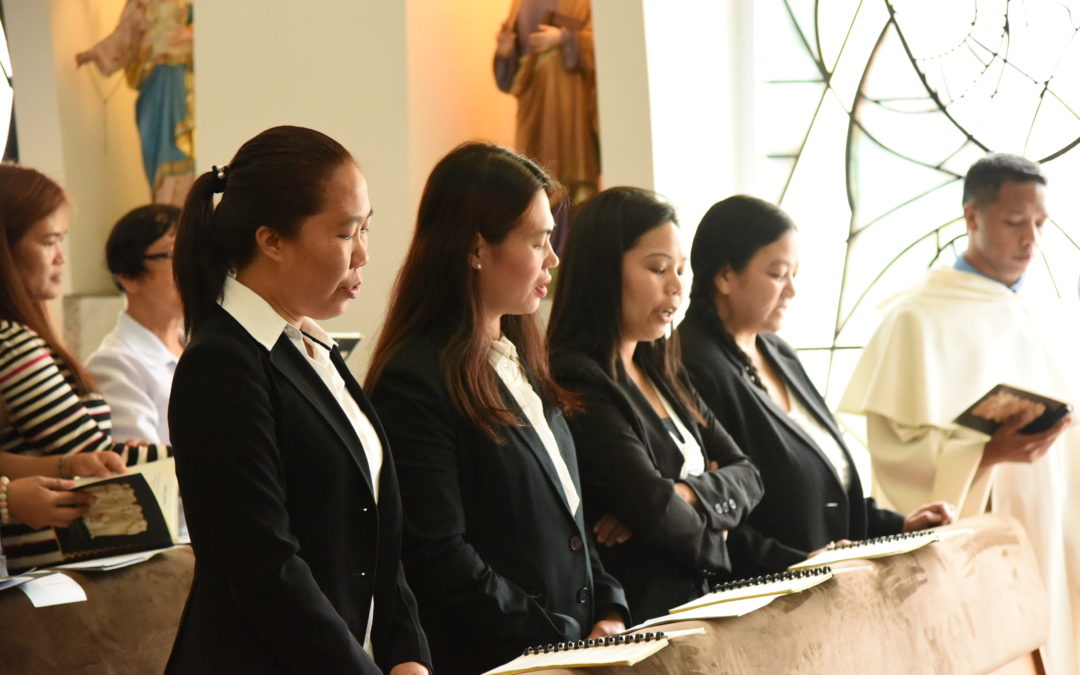
The first batch after a period of three years decided to make their first commitment with the consent of Fr. Provincial, Fr. Javier Gonzalez, O.P. They are Ana Francia de Guzman, O.P., France de Guzman, O.P., Miriam Zingapan, O.P., and Selina Ebora, O.P.
Thinking of how to name the group, I did not hesitate since the dream was prescient due to a play of words in Latin: although Father Dominic named it Order of Preachers, it would later come to be known as the Dominicans; in Latin, that Dominican, which is very similar to Domini Canis, or dog/hound of the Lord. Timely, Macau is drenched in materialism because of the presence of casinos all around. And so I have thought of a name suitable to what will become the mission of our Lay in Macau, to be faithful like our Father Dominic de Guzman in proclaiming the Gospel and guarding the faith and the truth from modern heresy; and to rouse people from today’s blind adherence to an ephemeral world; undoubtedly my brother priests agreed with me.
Indeed, this time was magnificent because the Lord’s preaching hounds unleashed a force meant to further fire up an already splendid 800-year-old service to the Catholic faith when the Order Our Lady of the Rosary Province celebrated a solemn mass in the Cathedral with the presence of the bishop, priests, religious, Lay Dominicans (from Hong Kong and Macau), the faithful, in this momentous event of the Order. That was a superb celebration!
Last April 29, the feast of our Sister Catherine of Siena, our Dominican Family was blessed by 4 Professed Lay Sisters who renewed their promise for a year, 4 Novices and 6 Postulants seeking a richer, deeper spiritual life while living in the world in personal and liturgical prayer, especially the Eucharist, in the common study and in everyday life experiences. They discern ways, with the help of a Spiritual guide and community of believers, to deliver the Word according to their abilities and the urging of the Holy Spirit. Although they are OFW workers, they are living a positive response to the Gospel message, sharing their faith to their families and even the family of their employers and friends, trying to combat the evil of the age by preaching the Truth of Christ. They are aware that Lay Dominican life is all about having a passion for the Word of God. It is about committing oneself to a community of like-minded brothers and sisters that immerse themselves in the Word of God. If you remain in my word, you will truly be my disciples, you will know the truth, and the truth will set you free (St. John 8:31-32).
Lastly, they are here with us now not only to enrich the Order, the Church, and the World around us through the richness of their vocation but to journey with us through the path that our Father Dominic had trudged.
We pray for these new members of our Order, the Lay Dominican- Torch of Macau, for their zeal and enthusiasm in illuminating at least this little corner of the world- Macau as faithful hounds of the Lord.
Father Dominic, pray for your sons and daughters, pray!
Sr. Maria Lourdes Blanca, O.P.
Missionary Dominican Sisters of the Rosary
Christian Attitudes toward War, Peace, and Revolution
It is a lifetime process to build up peace in the world. The family is at war, the societies also. The human being is losing the common points as race and each day enhancing the range of differences. So God created mankind in his own image, in the image of God he created them; male and female he created them God saw all that he had made, and it was very good. And there was evening, and there was morning ”the sixth day.[1]
The human being has forgotten these words, above all the statement all that he had made, and it was very good; by Creation, humankind has been made good and was given the most beautiful gift: Free Will. Freedom to be fruitful and increase in number; [to] fill the earth and subdue it. [To] Rule over the fish in the sea and the birds in the sky and over every living creature that moves on the ground.[2]
The Pilgrim, referring to Pope Francis in his message Nonviolence as a Style of Politics for Peace(January 1st, 2017), says that violence continues to abound in our hearts and in our world.[3] How far are human beings from that wonderful statement found in Genesis and it was very good? How are human beings understanding and putting into practice the expression fill the earth and subdue it? How is the human being using his/her free will? Here comes the main question: is it possible in the twenty-first century to have a peaceful world or is it simply a utopia, a dream that will never come true and that human beings will be the subjects and the objects of their destruction?
The panorama is as follows we live in a broken worldin a horrifying world where war is fought piecemeal. Pope Francis cries out that there is piecemeal violenceof different kinds and levels: war in different countries and continents; terrorism, organized crime and unforeseen acts of violence; and the devastation of the environment.[4]
In the author opinion, this worldview can change for good. God has given mankind the faculty of reasoning and the gift of freedom; has endowed it with faith, hope, and charity; has put men to take over the whole of creation; has given a law Loves Law to follow as a guideline in every single action; has given men the faculty of re-think on their own acts in order to make amendments; has placed humanity within an environment that provides all the resources needed for nourishment, sheltering, reproduction and amusement. Knowing all this, once again, the author states that the horrifying world described by Pope Francis can become a joyful and fruitful place.
If one asks others which is the origin of violence, for sure the answer will be hatred. Nobody will act violently if in his heart and thoughts love abounds. The second cause may be revenge. A heart that loves and a mind that thinks rationally, know, and trust in justice (earthly and divine): under this principle, there is no space for revenge.
The Catechism of the Catholic Church(CCC) states that By recalling the commandment, You shall not kill, our Lord asked for peace of heart and denounced murderous anger and hatred as immoral.[5] Moreover, Anger is a desire for revenge. To desire vengeance in order to do evil to someone who should be punished is illicit,but it is praiseworthy to impose restitution to correct vices and maintain justice. If anger reaches the point of a deliberate desire to kill or seriously wound a neighbor, it is gravely against charity; it is a mortal sin. The Lord says, Everyone who is angry with his brother shall be liable to judgment.[6]
This article in the Catechism shows an important point in today society: someone who should be punished Who is the one in charge of giving punishment to the one who deserves it? The correct answer is a legitimated governmental entity holding power, and therefore the duty, to render justice to the affected party. Inputting the word governmental in this context, it is necessary to come to realize that the idea of Pope Francis is the most suitable of all: Nonviolence as a Style of Politics for Peace . As long as the entities of justice, throughout the world, be corrupt and misdirected, there will never be justice, and the path towards peace will be tortuous and even unachievable. Peace is the tranquillity of order. Peace is the work of justice[7]
The Compendium of the Social Doctrine of the Churches (CSDC) writes that peace is the fruit of justice, (cf. Is 32:17) understood in the broad sense as the respect for the equilibrium of every dimension of the human person. Peace is threatened when a man is not given all that is due to him as a human person, when his dignity is not respected, and when civil life is not directed to the common good. The defense and promotion of human rights are essential for the building up of a peaceful society and the integral development of individuals, peoples, and nations.[8] To give each one all that is due to him is the definition of justice. If, injustice is one of the threats against peace the first step in the way heading a peaceful world ought to be purified and reorganize all juridical systems worldwide. Once again is a matter of politics.
Linked as well to the political system of the countries in the development of the nation, the welfare of the people, and the harmony within the boundaries and out towards the neighboring countries. Respect for and development of human life requires peace. Peace is not merely the absence of war, and it is not limited to maintaining a balance of powers between adversaries. Peace cannot be attained on earth without safeguarding the goods of persons, free communication among men, respect for the dignity of persons and peoples, and the assiduous practice of fraternity.[9]
How can one understand this balance of power that the Catechism mentions, when only watching the TV news is easy to realize that the power nowadays is not balanced at all? One group, the minority, holding power almost up to the point of absolute power; the other group enduring the situation speechless or silenced by force. The power is twofold: political of course and economical. There are adversary groups, but there are also those who belong to the same group challenging each other to have more and more. Years ago adversaries could be understood as countries in war because of the motive. In these times, adversaries can be, for instance, big companies trying to dominate excessively the market or those who are exploiting the natural resources irresponsibly and even shamelessly.
Once that human beings give up this savage competition, the goods of persons and free communication among men will be safeguarded, and the dignity of persons and peoples will be respected.
Gaudium et Spes (GS) says that In the economic and social realms, too, the dignity and complete vocation of the human person and the welfare of society as a whole is to be respected and promoted. For man is the source, the center, and the purpose of all economic and social life.[10]
Fraternity, friendship, real community life, transparent relationships among human beings that live in a particular environment is only attainable through love. According to CSDC Peace is also the fruit of love. True and lasting peace is more a matter of love than of justice because the function of justice is merely to do away with obstacles to peace: the injury did or the damage caused. Peace itself, however, is an act and results only from love[11] Therefore the first value to be considered in this style of politics must be Love.
The words of Saint Paul are a reminder to all human beings We know that the whole creation has been groaning as in the pains of childbirth right up to the present time. Not only so, but we ourselves, who have the first fruits of the Spirit, groan inwardly as we wait eagerly for our adoption to sonship, the redemption of our bodies.[12] The whole creation is, at this moment, suffering and struggling to achieve means to survive in a more and more challenging historical moment. The earth and its resources are being exhausted, peoples fighting each other to possess such resources. If the style of politics is going to be love, human beings must learn how to love the earth and out of love to distribute the resources available in it.
As the earth is suffering so too the people; this suffering will finish, gradually, when human beings come to realize that a peaceful world is not a utopia but a reality that can be achieved through the effort and collaboration of all.
The way towards a peaceful world is marked in the Sermon on the Mount, the program that Jesus designed for human beings to achieve salvation while enjoying life on earth. The hard sayings of Jesus will be no longer hard because there will not be evildoers, nobody will strike the other cheek, people will be able to share and walk together, there will be no more persecutions and the word enemy may be erased from the dictionary.[13]
Since Jesus, it is possible to be gathered from the diaspora, to join together and to be disciples. The Church way is the way of communities. Even if they are small in comparison to the rest of society they can, through their example effect more in the world than anything else can imagine.[14]
References
Catechism of the Catholic Church.
Compendium of the Social Doctrine of the Church.
Gomez, Fausto OP. Mercy Love and Holiness. Manila, PHL: University of Saint Thomas Publishing House, 2017.
Lohfink, Norbert. Church dreams: The Road from Violence. North Richland Hills, TX: Bibal Press, 2000.
Pastoral Constitution on the Church in the Modern World Gaudium et Spes.
108
[1] Gen 1: 27-31
[2] Gen 1: 28
[3] Fausto Gomez, OP, Mercy Love and Holiness (Manila, PHL: University of Saint Thomas Publishing House, 2017), 155.
[4] Fausto Gomez, OP, Mercy Love and Holiness (Manila, PHL: University of Saint Thomas Publishing House, 2017), 155.
[5] Catechism of the Catholic Church (CCC) 2302.
[6] CCC 2302.
[7] CCC 2304
[8] Compendium of the Social Doctrine of the Church (CSDC) 494
[9] CCC 2304
[10] Pastoral Constitution on the Church in the Modern World Gaudium et Spes (GS) 63
[11] CSDC 494
[12] Rom 8:22-23
[13] Cf. Mt 5:39-44
[14] Norbert Lohfink, Church dreams: The Road from Violence (North Richland Hills, TX: Bibal Press, 2000),
Bro. Reynaldo Chang, OP.

When in September 2011 I received the document through which the Master of the Dominican Order established “The Center of Institutional Studies for the Province of Our Lady of the Rosary in the Convent of St Dominic, Macau in China†I realized that we were writing history. Something extraordinary was there: A Dominican Center of Studies [Studium Generale] in Macau! A dream many of our former missionaries would have longed to hear. We are privileged to witness it and hopefully appreciate its implications.
What is a Center of Studies? A Center of Studies is basically a community of learning and formation. These kinds of Centers enjoy their own personality, and great importance is attached to them in the Dominican tradition. To the point that our legislation states that “each Province shall have its own Center of institutional studies.†(LCO 233 §I)
We, the Province of Our Lady of the Rosary are not an exception: we have always had one; furthermore, even more than one at a given time in history, in different parts of the world, depending on where our House of Studies was. The latest was in Madrid, San Pedro Mártir, which for 50 years fulfilled a splendid mission in the formation of this present generation of missionaries. But today the situation has changed and our provincial Student is here in Macau. And since new situations require new solutions, our Center of Institutional Studies is here in Macau, too.
What is the specific significance of this Centre for our Province? It is a great one for us Dominicans and for the Church:
- In the first place, it addresses our academic needs at this moment in history, bound as we are to provide our numerous students with the required philosophical-theological formation in accordance with the Dominican tradition.
- In the second place, this Centre is called to become a reference point for the Province in this part of the world in fulfilling the important tasks of promoting scientific learning and of keeping us in touch with other academic institutions and with the university world of the region. And
- Finally, this Center has also for us a practical significance, as an internal coordinating platform for the studies of those students of ours who are taking their institutional courses in other nearby places, as well as an important aid in facilitating transcript of records, accreditation of studies, needed documents for visa purposes, etc. The establishment of this Centre is a much-needed institution and quite timely at this point in history.
In closing, I just simply say that if the establishment of this St Dominic Center of Studies is history, our current presence here is history, too.
May our Brother St Thomas Aquinas, known for his holiness and learning, help us to grow in wisdom by his teaching and in holiness by imitating his faith. Amen.
 Fr Javier González, OP