Journeying Together as Dominicans
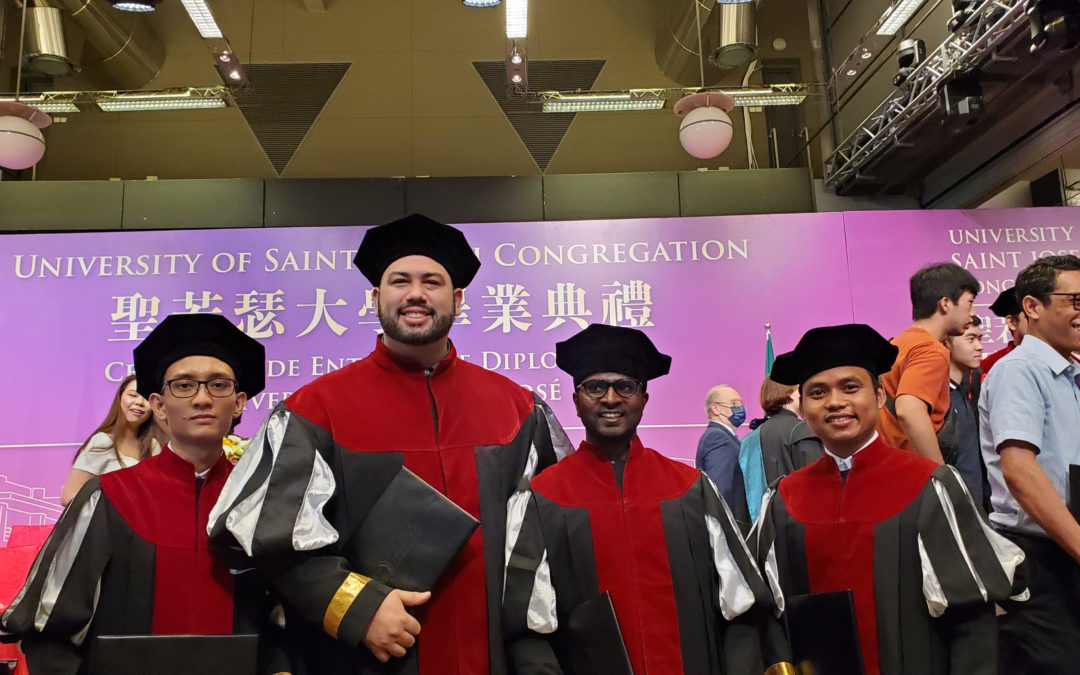
Life is a journey! Student life is a journey! Religious life is a journey, too, indeed a unique or distinctive journey! Being both students and religious, graduation is quite an experience for us journeying together.
There is a saying, “if you want to walk fast, walk alone. However, if you want to walk far, walk with others.†I am convinced that this saying is particularly suitable for religious life, in which fraternal life is lived in the community. The strength of being in a religious community is to help one another when one is not in the right condition physically, spiritually, or intellectually. There is no room in it for individualistic approaches. He who is a religious community pursues his own interests and projects without being sensitive to others may perhaps achieve them, but he will not find anyone beside him to celebrate it together or to share his joy with.
Celebration never takes place in solitude. It occurs only in the community, as it is a joy to be shared.
As a Dominican, journeying together with one’s own community is something essential because community life is one of the four pillars of Dominican spirituality.  Accomplishing something together with others makes it truly enjoyable and meaningful since such joy is to be shared. That is the case with the group of Dominican brothers who this year graduate after five years of study in USJ.
We give thanks to the Lord for His many blessings bestowed on us throughout these years.
And we thank our fellow Dominicans [and the USJ academic community] with whom we journey together.
Author. Gabriel Kyaw Ko Ko, OP
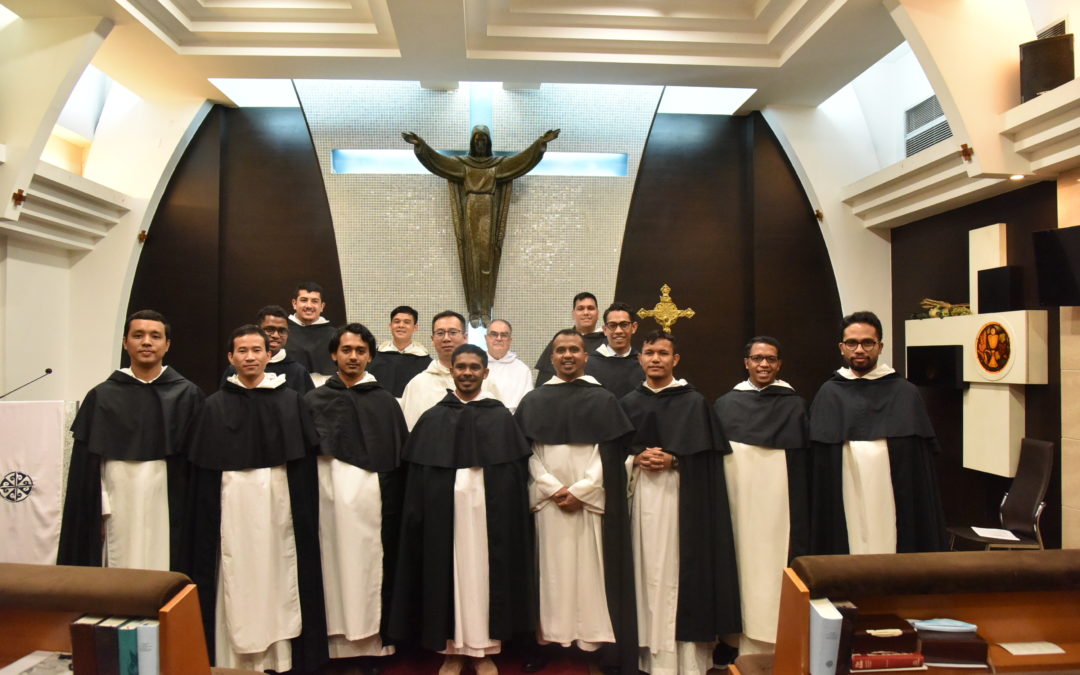
On 21 June 2021, a group of 13 Dominican Student Brothers had their profession renewal in Macau. They promised obedience, chastity, and poverty to God, although only one of the three evangelical counsels Obedience is mentioned in the Dominican Order. This event has brought home to my mind a few thoughts that I wish to share in these lines.
Promising obedience to God means submitting ourselves to Him, listening to Him. In fact, the word “obedience [from the Latin ob-audire] means, in the theological reflection, listening. Listening to God is a way to express our intimate relationship with Him who has spoken and keeps calling to each of us through our hearts and minds. The Lord has called to follow Him in a special way; that is why we name it vocation and it is a privilege, a divine gift.
In promising obedience to God, we do not lose our freedom; rather we regain it! Why? Because we say yes to Him freely, without force or fear. Truly, there are renunciations in it, like other people (for instance, in marriage, in social duties) or like in the case of Jesus, who sought the will of his Father as the food who nourished his life; even in the difficult moments of the cross, he kept bedient until death seeing in such obedience a loving gift. Our religious renunciation does not mean losing our freedom? On the contrary, in the Christian understanding, religious obedience to God implies an intimate relationship with God.
God calls us since we were born: You did not choose me but I chose you (John 15:16); each of us has received from birth a special gift from God. He already knew what we were going to be in the future, while we when we are only dreaming to become someone as we grow old. Our parents may choose to have us, but they cannot choose what we are to be.
So, our Profession Renewal or Vows renewal simply means looking forward to our solemn profession, which is made until death. Religious life is a radical following of Jesus’ poor, chaste, and obedient. All things were done by Jesus according to His Father’s will. In the Garden of Gethsemane, His obedience was demonstrated by His acceptance of the cup of suffering. Throughout the Gospels, Jesus seeks the will of His Father in prayer. Obeying for him did not mean submission to tyrannical power, as it is the connotation in contemporary society. Obedience for Jesus was really an act of trust in His Father. Proportionally in our case, when we obey our religious superiors do so because we trust that, as legitimate authorities, they have our best interests at heart – leading us to what we could not or would not otherwise pick by ourselves.
For instance; I may be unwilling to obey traffic laws, but I trust they exist to protect me and people. This statement is indeed true because, in my driving, I could be so selfishly speeding toward my destination that I might not think of the safety of other people. To remind me that this should not be the case, the trusted authorities enact laws. In the same way, Jesus obedience was an expression of love and active trust. It is exactly the same love and trust that the religious profess when taking their solemn vow of obedience. Indeed, their vow of obedience is really a vow of trust in God first and foremost, even if they promise it also to their constituted religious superiors. The freedom they have regained is their full dedication to God’s service.
Bro. Cesar De Sousa OP.
We are Dominicans
We are members of the Order of Preachers, founded at the beginning of the thirteenth century by St Dominic of Guzman, which was established expressly for the preaching of the Good News for the salvation of souls. This Order of Preachers is made up of various Provinces. One of them, to which we belong, is the Province of Our Lady of the Rosary, missionary in character, present today in around 13 countries.
We Come from Different Regions and Walks of Life
Spain, China, Japan, Vietnam, Philippines, South Korea, Myanmar, East Timor, Singapore, Venezuela.
Pre-novitiate
The Pre-novitiate is the first stage of formation. It comprises two years and two stages–the aspirancy and the postulancy–in which the candidate gets to know the Dominican friars and their lifestyle, living with them. They also dedicate time to study languages, especially English, and to acquire firsthand experience of this new way of life.
Novitiate
It is one year of intense formation for encounter with Jesus, for immersing oneself in the Religious Life and the Dominican Spirituality, and for familiarization with the history of the Order of Preachers.
Studentate
The Studentate is a five or six-year period of formation on Dominican spirituality and community life, during which the brother continues to attain maturity, consolidation, and development of that Dominican spirituality already initiated in the Novitiate. The Studentate is a time of intense study, blended with some pastoral experiences proper to the Order. And it is a time for greater integration of two different elements, namely, the Dominican life and the plan of studies proper to it. Both of them are ordained to preparing the students for their future mission as priests and Dominicans.
Further Studies
We normally follow complementary or specialized studies, focused on the requirements of the future mission to be entrusted to the different brothers, and according to their own personal interests and talents.
We Work in Different Areas
Education, Research, Pastoral work, Retreats, Preaching, working with the various social groups, particularly the poor, etc.
Laudare, Benedicere, Praedicare
“To praise, to bless, to preach”: This is one of the mottoes of the Order of Preachers, and, therefore, our motto, our way of life, and our mission.
Veritas, Truth
The quest and effort to study in search of the truth, and the preaching of the Truth for the well-being of our people is the identity of each Dominican.

St. Dominic in Macau started walking in 2007. It is a Dominican community belonging to the Province of Our Lady of the Rosary, which is a missionary Province of the Order of Preachers (also known as the Dominicans). By the way, the Dominicans initiated their presence in Macau as early as 1587. In fact, the primitive house of St. Dominic is considered the second oldest house of the Province, the first one being Santo Domingo in Quezon City, Manila, Philippines.
The community of St Dominic’s Priory in Macau is currently composed of thirty-four (34) Dominican friars, of whom 10 are priests and 24 are simple-professed student Brothers. All of the 24 are enrolled at the University of St Joseph (USJ), pursuing the 5-year institutional studies program of the Faculty of Religious Studies and Philosophy. Due to the coronavirus restrictions, six students are currently following the courses online from Hong Kong, as they cannot so far enter Macau.
As for the ten Dominican priests, four of them are currently pursuing graduate studies at USJ. Even so, they and the rest of the Fathers are directly involved in either preaching, teaching, writing, or engaging information and in the education apostolate. In fact, four of them are working in the diocesan school of St Paul and the other five are committed to Dominican formation or teaching at the University of Saint Joseph. Some priests are also involved in pastoral work in the diocese, as in celebrating the Eucharist and the Sacrament of Reconciliation in parishes or in religious communities.
The whole community participates in the daily liturgy of the Priory Chapel, which is open to the outside religious and lay faithful. The main event is the Sunday Mass, at eleven in the morning. All the members of the Priory are likewise members of the Association of Macau Religious Men (AMRM), participating in its regular activities throughout the year, and a few represent the community in the monthly meetings of the Association.
This Priory houses also the Provincial Studentate and the Center for Institutional Studies. Henceforth, it plays an important role in the Province as far as religious vocation promotion is concerned, focused not so much on recruiting new vocations, but rather on forming those who have joined us. This factor adds a typical characteristic to this community, namely, to be truly international and intercultural, as it gathers brothers from nine different nationalities.
Prayer, Study and Fraternal Life in common
Inside the Priory’s walls, the community of Brothers, consecrated by the profession of the evangelical counsels of poverty, chastity, and obedience, hold regular observances, marked by a daily schedule of prayer, study, and community life.
Prayer: We start our day by praying the Rosary in honor of Our Lady, the Patroness of the Province; then, we have the Morning Prayer (Lauds) integrated with the Eucharistic celebration. Parallelly, every evening we have together a 15-minute period of meditation, followed by Evening Prayer (Vespers) and the Office of Readings. In the late evening, the student brothers close their hour of common study with the Night Prayer. The community also holds an annual retreat, which usually takes place during the Holy Week. We invite also Brothers and Sisters from other religious Congregations in Macau to give us some talks. We have Eucharist Adoration once a month and other moments of personal prayer, aimed at fostering spiritual growth and ongoing conversion.
Study: Study is an essential part of our Dominican tradition. In fact, the book Constitutions of the Order of Preachers stresses the vital role study has ever had in Dominican life from the time of its foundation by St Dominic. This is very relevant today as our society values studies and education so much that, without them, there is no place to work for daily survival. Still, for us Dominicans, the study is not simply ordered to get a job or to earn a living, but it is rather part of our spirituality: we study to become preachers, which is our charism. This explains why practically all the members of St Dominic’s Priory are involved in academic activities, whether at St Paul’s School or mainly studying and teaching at St Joseph University. The Priory houses also a good library for the service of the brothers.
Common life: Inside the Priory’s walls, an outstanding fraternal atmosphere and coexistence among all the members prevails, something that has been taking place throughout the years.
A positive characteristic of our community is, for instance, the joy of our domestic celebrations: weekly social activities, birthday celebrations, anniversary celebrations, special feasts, etc.; these show the standing fraternal relationships prevailing in the community as well the generous mutual help and collaboration among its members. There is an equally good collaboration, great respect, and a sense of evangelical justice towards our employees. The brothers, likewise, enjoy the community recreation time. All this is more admirable when our great differences (cultural, ethnic, linguistic, educational, etc.) are considered.
The community tries to be faithful to its responsibilities regarding its scheduled religious observances. At times, however, this is not without some difficulties, due to the different schedules, commitments, absences, and the like of the brothers.
Looking at the future with hope
It is a great joy for the current priests and students of the Priory to realize that a good number of their former student brothers in Macau are now Dominican priests working for God’s Kingdom in Myanmar, Korea, Japan, Taiwan, Hong Kong, Philippines, East Timor and even in Spain and Venezuela. As they continue their journey in Macau, the members of St Dominic’s Priory are trying to do better what they have to do, above all, concerning their two main commitments, namely Catholic education, and the philosophical and theological formation of their student brothers.
Certainly, and as long as our Center of Institutional Studies continues in Macau, the Dominicans wish to be part of common projects of the religious men and women in Macau and particularly of the diocese.
The happiness of witnessing the yearly professions of their brothers in formation, the ordination to the priesthood of those brothers who came to their community searching for their real identity, the passing of the torch of their ancestors to establish the Dominican Order, and, in a special way, the charism of the Our Lady of the Rosary Province among other people, are visible in the community. They are visible not because the members of the priory waited for it, but because, like the first three friars who arrived in the territory of Macau in 1587, and the brothers of the Province of Our Lady of the Rosary along all these years, they also respond with a willingness to be open and sent in answer to God’s invitation.
Faithful to a glorious past, which began here with the first three friars who arrived in the territory of Macau in 1587, and marching towards a hopeful future, the Dominicans in Macau walk in the present by steps of creative fidelity to their Dominican and missionary vocation and to love for humanity. Thus, we celebrated gratefully and joyfully the Jubilee 800 of the establishment of the Dominican Order in 1216, and, in this current year 2021, the Jubilee 800 of the death of our Founder St Dominic de Guzman.